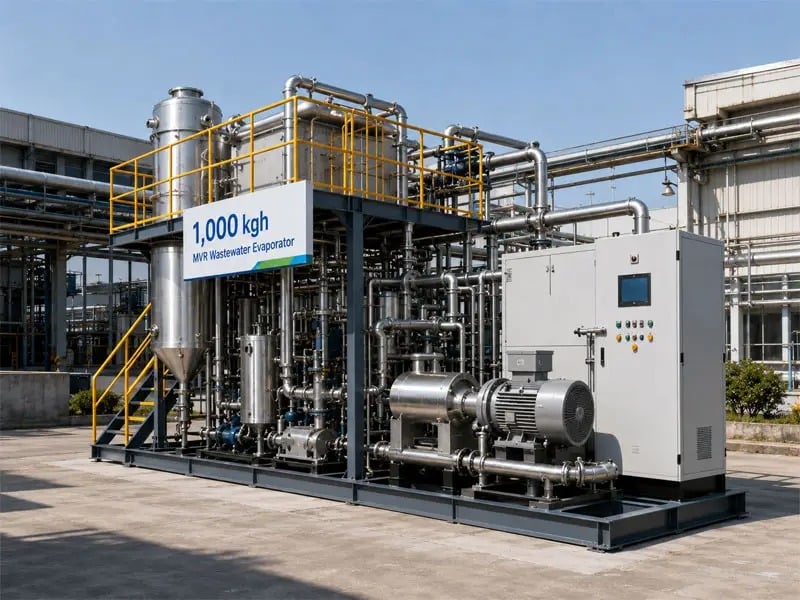
Selecting the right evaporator technology is critical for industrial concentration processes. A forced circulation evaporator and a falling film design represent two distinct approaches to thermal separation, each optimized for different feed characteristics and operational demands. Understanding when to deploy each technology prevents costly inefficiencies and equipment damage.
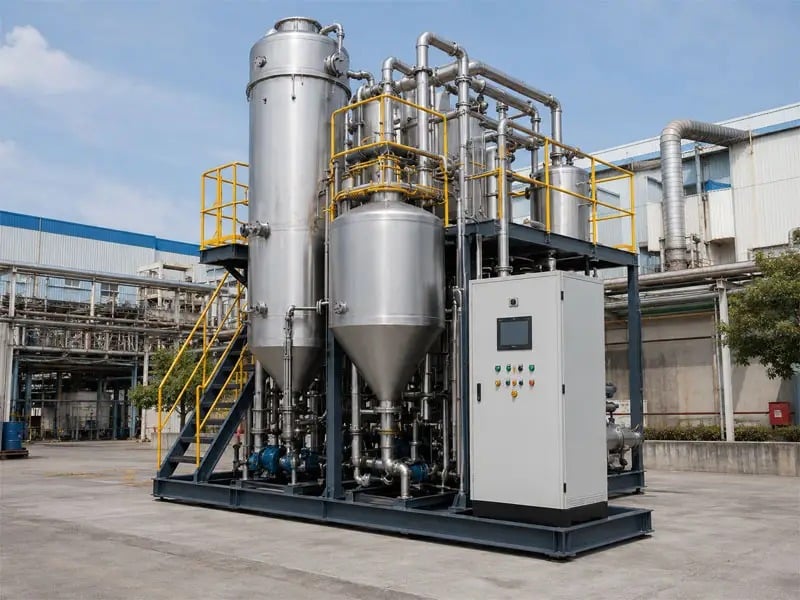
Both evaporator types address concentration and water removal, but their internal configurations and heat transfer mechanisms differ substantially. The forced circulation design uses mechanical circulation to push liquid through heated tubes, while falling film technology relies on gravity and thin-film contact to transfer heat. Your choice depends heavily on feed properties, target product quality, and throughput requirements.
Feed Viscosity and Solids Content Determine Technology Fit
Why Viscosity Matters in Evaporator Selection
Feed viscosity is the primary technical factor separating these two designs. Falling film evaporators perform exceptionally well with dilute, low-viscosity feeds where the liquid forms a thin, coherent film down the tube wall. Once viscosity climbs, falling film technology loses efficiency because the liquid cannot maintain even distribution across the tube bundle. A forced circulation evaporator excels under these conditions because mechanical pumping ensures uniform flow and constant contact with heated surfaces regardless of viscosity level.
In pharmaceutical, chemical, and food processing applications, feeds often contain dissolved salts, sugars, or organic compounds that increase viscosity as evaporation progresses. When your product's viscosity exceeds 500 centipoises during the evaporation process, forced circulation becomes the safer, more reliable choice. The pump maintains shear forces that prevent stagnation and uneven heating, protecting product quality and preventing tube fouling.
Solids Handling and Fouling Risk
Falling film designs are vulnerable to solids accumulation because suspended particles or crystalline materials settle in the downcomer regions and tube bottoms. Once solids deposit on heated surfaces, they create insulating layers that reduce heat transfer efficiency and require frequent cleaning cycles. A forced circulation evaporator's pump continuously resuspends solids, preventing settlement and reducing fouling likelihood by 60 to 75 percent in typical dairy, juice, and pharmaceutical applications.
If your feed contains more than 5 to 10 percent total solids by weight, or if evaporation will concentrate solids to 15 percent or higher, forced circulation is mandatory. The mechanical circulation maintains particle mobility, extends time between cleanings, and protects against the catastrophic heat-exchanger fouling that can halt production for days during falling film operation.
Heat Transfer Efficiency and Evaporation Rate Considerations
Comparing Overall Heat Transfer Coefficients
Falling film evaporators achieve higher heat transfer coefficients—often 2500 to 4500 watts per square meter per degree Celsius—when conditions are ideal. This advantage holds for clean, low-viscosity feeds such as dilute juice concentrates, whey, or seawater desalination. However, this theoretical superiority collapses when feed properties deviate. A forced circulation evaporator typically delivers 1200 to 2500 watts per square meter per degree Celsius but maintains stable, predictable performance across a wide range of feed conditions.
In industrial evaporation practice, reliability and consistency outweigh peak performance under optimal conditions. A forced circulation evaporator's lower but stable heat transfer coefficient means you can accurately predict steam consumption, product throughput, and operational costs. This predictability translates to lower energy waste, fewer unexpected shutdowns, and better control over the evaporation process. For applications where feed properties vary batch-to-batch or where product quality depends on precise temperature control, forced circulation's steady performance is invaluable.
Temperature Sensitivity and Product Quality
Falling film designs expose the product to high local temperatures for short contact times, which suits robust products but risks degradation of heat-sensitive materials like vitamins, flavor compounds, and bioactive proteins. The thin film concept assumes rapid evaporation, but if residence time extends because of unexpected viscosity changes, product degradation accelerates. A forced circulation evaporator operates at lower bulk temperatures because the pump-driven circulation allows longer residence times without excessive local heating.
Thermal-sensitive products—such as milk proteins, pharmaceutical actives, or specialty chemicals—benefit from forced circulation's moderate temperature environment. The continuous mixing and circulation ensure uniform temperature exposure, preventing hot spots that degrade sensitive compounds. If your product specifications require outlet temperatures below 60 degrees Celsius or if thermal history limits total heat exposure, a forced circulation evaporator provides superior product protection than falling film technology.
Operational Complexity, Maintenance, and Total Cost of Ownership
Maintenance Requirements and Downtime Risk
Falling film evaporators feature simpler mechanical design with no internal pumps, making them attractive for low-maintenance operations. However, their vulnerability to fouling and solids buildup creates hidden maintenance costs. Cleaning cycles for falling film equipment often require 8 to 16 hours per occurrence and demand chemical solvents that add operational expense. A forced circulation evaporator requires pump maintenance and occasional seal replacement, but these tasks are routine and predictable.
When comparing total cost of ownership over five years, the forced circulation evaporator frequently demonstrates lower overall expense because cleaning frequency drops by 50 to 70 percent and unplanned shutdowns decline significantly. For 24/7 production environments, this reliability difference translates directly to revenue protection. Forced circulation equipment also accommodates easier scale-up and higher throughput without design modification, making it suitable for growing operations.
Control and Operability in Production Settings
A forced circulation evaporator provides superior process control because the pump speed, feed rate, and temperature can be independently adjusted to optimize evaporation efficiency and product quality. Operators can respond quickly to feed composition changes, seasonal variations, or market demand shifts without equipment redesign. Falling film systems operate in fixed-point mode and resist adjustment; once tube configuration is set, modifying performance requires significant process rework.
In food processing, pharmaceutical, and specialty chemical industries where regulatory compliance and batch traceability matter, forced circulation's controllability provides documented audit trails and repeatable process parameters. Product consistency improves, regulatory documentation becomes easier, and qualification studies proceed faster because operational variables remain stable and controllable.
FAQ
When should I choose a falling film evaporator over forced circulation?
Falling film technology remains optimal for dilute, low-viscosity feeds with minimal solids content—such as fresh fruit juice, whey permeate, or clear sugar solutions—where peak heat transfer efficiency justifies the design. If your feed viscosity stays below 50 centipoises throughout evaporation and solids content remains negligible, falling film's higher theoretical efficiency and simpler mechanics may justify its use despite lower robustness margins.
Can a forced circulation evaporator handle extremely high viscosity without special modifications?
Standard forced circulation designs accommodate viscosity up to 5000 to 10000 centipoises through properly sized pump selection and tube diameter optimization. However, extremely viscous feeds exceeding 15000 centipoises may require specialized heat exchange geometry or multi-stage circulation strategies. Consult equipment manufacturers to confirm mechanical circulation capacity matches your specific feed properties before final equipment selection.
How do fouling rates compare between the two evaporator types in real production?
Falling film evaporators experience fouling rates 3 to 5 times higher than forced circulation equipment when processing feeds containing more than 8 percent solids by weight. A forced circulation evaporator's continuous mechanical resuspension prevents settled deposits from forming insulating layers. For feeds with suspended solids or crystallizing products, forced circulation typically extends cleaning intervals from weekly schedules to monthly or quarterly cycles, substantially reducing maintenance labor and chemical consumption.

 EN