Organizations managing wastewater treatment operations face a critical decision when planning for future capacity needs. Should you invest in a complete system upfront, or adopt a phased approach? A modular wastewater treatment plant offers flexibility that makes phased installation an increasingly attractive option for facilities anticipating growth, regulatory changes, or uncertain demand trajectories. This strategy allows operators to deploy treatment capacity incrementally, aligning investment with actual operational needs while maintaining financial agility.
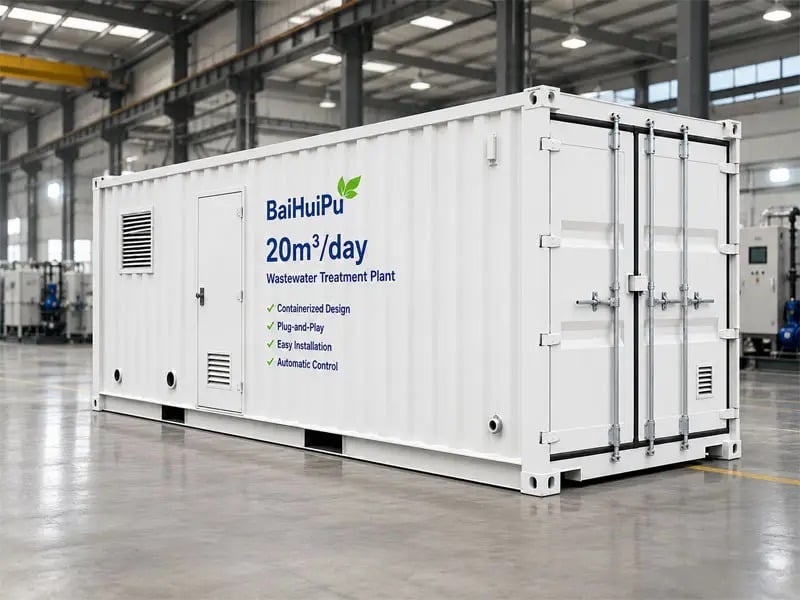
Phased installation represents a practical approach to managing capital expenditure while scaling treatment infrastructure. Instead of deploying all treatment modules simultaneously, operators activate modular components as demand increases, regulatory requirements change, or operational insights suggest the need for expanded capacity. This method is particularly valuable in industries where wastewater volumes fluctuate seasonally, where regulatory frameworks evolve, or where facility footprints remain constrained by space limitations.
Understanding Modular Design and Phased Capacity Deployment
How Modular Architecture Enables Incremental Growth
A modular wastewater treatment plant is engineered as a collection of self-contained treatment units that function independently or in concert. Each module performs specific treatment functions—primary clarification, biological oxidation, secondary settling, or tertiary polishing—and connects to a central control and distribution system. This design philosophy fundamentally differs from conventional monolithic plants, where treatment stages are fixed and built into rigid concrete structures. Modular systems allow operators to install only the capacity needed today, then add identical units as throughput increases. The modular architecture ensures consistent performance across all phases of installation while maintaining design flexibility for future expansion.
Capital and Operational Cost Advantages
Phased installation using modular expansion reduces financial risk by distributing capital investment across multiple years. Rather than committing $2–5 million upfront for a complete facility, organizations deploy Stage 1 capacity for a fraction of that cost, then add Stage 2 and Stage 3 modules as revenue or demand justifies the additional investment. Operating costs also align better with throughput; idle treatment capacity generates overhead without proportional benefit. With a modular approach, treatment stages operate closer to design loading, reducing energy consumption and chemical dosing compared to oversized monolithic systems running at partial capacity.
When Phased Installation Becomes the Superior Strategy
Uncertain or Fluctuating Demand Trajectories
Organizations facing unpredictable wastewater volumes should strongly consider phased installation. Industries subject to seasonal variation—food processing, beverage production, or hospitality—generate effluent loads that swing dramatically between peak and off-peak periods. A modular wastewater treatment plant can be sized to handle average conditions initially, then expanded to accommodate peak capacity without forcing year-round overdimensioning. Additionally, facilities in growth markets or expanding industrial zones can deploy initial treatment capacity for current operations while preserving the option to add modular units as their tenant base or product lines scale. This approach avoids the common pitfall of oversizing infrastructure for speculative future demand.
Regulatory and Environmental Compliance Drivers
Environmental regulations evolve, and wastewater discharge standards often tighten over time. Phased expansion allows treatment facilities to incorporate improved or additional modular technologies in later phases without retrofitting the entire existing plant. For example, if nutrient removal becomes mandatory, Stage 2 of your modular system can include dedicated nitrification-denitrification modules while Stage 1 continues basic biological treatment. This regulatory responsiveness is far more cost-effective than redesigning and reconstructing a conventional plant. Similarly, if a facility acquires adjacent properties or consolidates operations, phased modular expansion can incrementally absorb new process streams without complete system replacement.
Space and Site Constraint Scenarios
Facilities with limited buildout space benefit significantly from phased installation strategies. A modular wastewater treatment plant occupies a smaller footprint than equivalent conventional capacity because treatment stages are vertical or compact skid-mounted arrangements rather than sprawling concrete basins. Phased deployment further optimizes site utilization by constructing only necessary infrastructure in Year 1, leaving space available for future modular additions. This is especially relevant for industrial facilities in dense urban zones, manufacturing parks with restricted zoning, or properties where land acquisition costs are prohibitive. Over time, as operational needs clarify and capital becomes available, additional modular units integrate seamlessly into the existing footprint.
Evaluating Your Capacity and Expansion Needs
Assessing Current and Projected Treatment Demand
Before committing to a phased installation strategy, conduct a thorough analysis of baseline wastewater volumes, seasonal or cyclical patterns, and growth assumptions. Gather 12–24 months of historical flow data to establish realistic baselines. Project future loads based on facility expansion plans, market forecasts, and documented growth trajectories. A modular wastewater treatment plant sized for Stage 1 should handle current average flows with sufficient buffer for normal variation, typically 80–90% of Stage 1 design capacity. This approach ensures reliable performance while avoiding unnecessary oversizing. Engage process engineers to model expansion scenarios and determine optimal module sizes and sequencing.
Financial Planning and Capital Staging
Develop a multi-year capital investment roadmap that aligns modular expansion phases with projected cash flow, available budgets, and financing windows. Phased installation spreads costs across multiple fiscal periods, improving balance sheet management and reducing the need for large debt financing. Calculate the net present value of phased scenarios versus full upfront deployment to ensure the strategy delivers genuine economic benefit. Consider operational cost savings from avoiding idle capacity, reduced chemical and energy consumption during ramp-up phases, and flexibility to defer later phases if market conditions shift. Many organizations find that phased deployment recovers implementation costs within five to seven years through operational efficiency gains alone.
Operational and Technical Readiness
Ensure your operations team can manage the transition and integration of new modular units as installation phases progress. Staff training, control system integration, and process optimization become ongoing activities rather than one-time startup events. A modular wastewater treatment plant requires clear operational protocols for load balancing, switching between modules, and responding to equipment failures across distributed stages. Work with system integrators and control vendors to establish standardized monitoring, alarm systems, and maintenance procedures that accommodate growth. Phased implementation also provides valuable operational learning; insights from Stage 1 operation inform design refinements and optimization opportunities for subsequent phases.
FAQ
What is the typical payback period for phased modular expansion versus upfront installation?
Payback periods vary by facility, but phased expansion typically recovers incremental costs within 5–8 years through operational savings, reduced financing costs, and avoidance of idle capacity charges. Organizations processing moderate to high wastewater volumes with growth potential see faster payback because Stage 2 and Stage 3 modules operate at higher utilization from startup. Facilities with highly predictable, flat demand may see longer payback periods because the advantages of phased expansion diminish when capacity is always fully utilized. A detailed financial model specific to your facility, modeled against projected flows and energy costs, provides the most accurate payback estimate.
Can a modular wastewater treatment plant handle mixed wastewater types across different phased installations?
Yes, modular systems are designed to accommodate varied influent characteristics across multiple phases. Each module can be configured with different treatment chemistries, biological cultures, or settling kinetics to address specific contaminants. If Phase 1 processes municipal wastewater and Phase 2 incorporates industrial process effluent, the modular architecture allows Stage 2 to include specialized treatment units tailored to industrial contaminants without disrupting Stage 1 operations. However, pre-treatment and equalization pools should be sized to handle the full blended flow to ensure consistent downstream treatment across all modular units.
Are there regulatory or permitting complications with phased installation of modular treatment systems?
Phased installation may require adjusted permitting depending on local environmental regulations and local authority requirements. Some jurisdictions allow staged discharge permits that increase allowed flows as each phase becomes operational, while others require a single comprehensive permit covering full build-out capacity. Early coordination with regulatory agencies during planning prevents delays and ensures phased expansion timelines align with permitting cycles. Document your modular wastewater treatment plant design to clearly show Stage 1 discharge limits, Stage 2 and Stage 3 expansion pathways, and the technical mechanisms ensuring compliance at each phase. This transparency typically accelerates approval and demonstrates good faith environmental stewardship to regulators.

 EN






