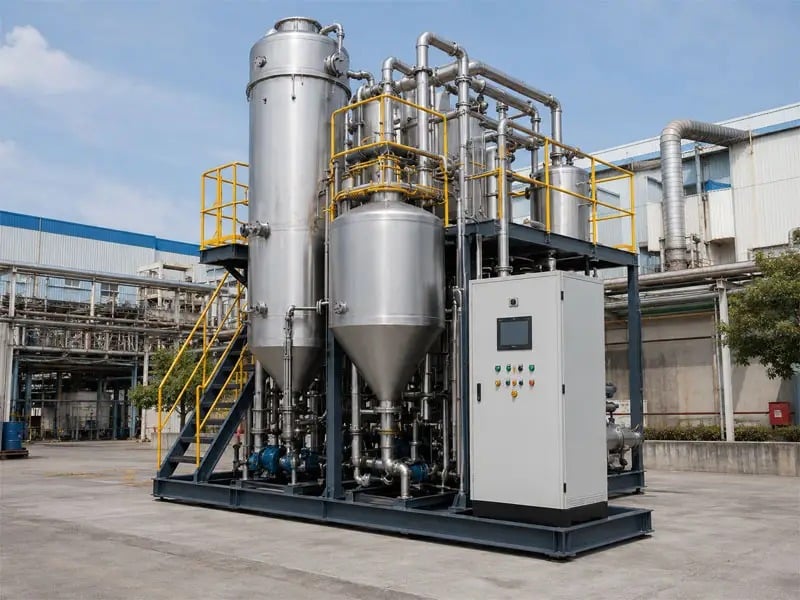
In industrial wastewater treatment, the performance of your evaporation system directly impacts operational efficiency, maintenance costs, and environmental compliance. The forced circulation type evaporator has become the preferred solution for handling complex effluent streams, but many operators overlook a critical factor that determines long-term success: circulation rate. Understanding why circulation rate matters is essential for optimizing evaporator performance and avoiding costly downtime.
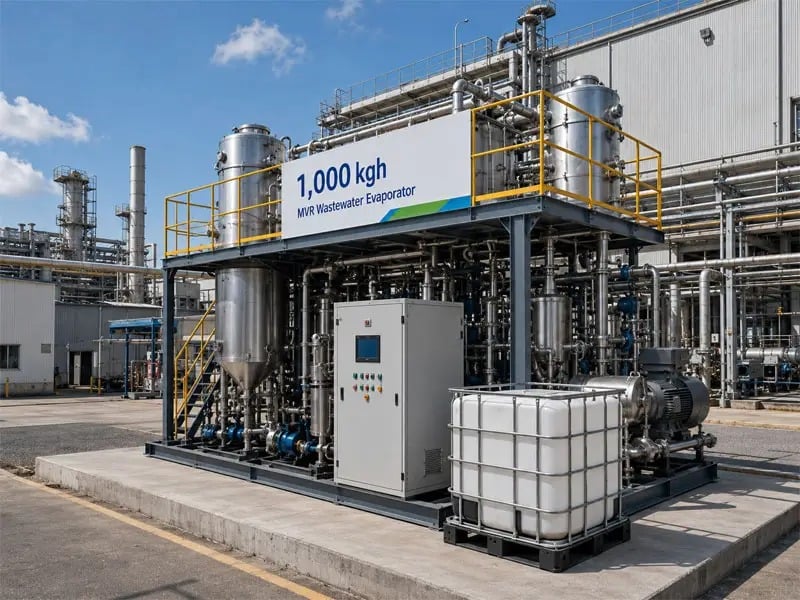
Circulation rate represents the volume of liquid moving through the evaporator chamber per unit time, and it fundamentally shapes how your system manages heat transfer, prevents scaling, and controls brine concentration. When circulation rate drops below optimal levels, scaling accelerates, heat transfer efficiency declines, and maintenance intervals shorten dramatically.
The Role of Circulation Rate in Heat Transfer Efficiency
Understanding Forced Circulation Dynamics
A forced circulation type evaporator relies on mechanical pumping to move liquid through the heating surfaces at controlled velocity. Unlike passive evaporation systems, this active circulation ensures consistent contact between the liquid and heat transfer surfaces, maximizing the energy transfer rate. The circulation rate directly determines the film coefficient on the liquid side, which is the rate at which heat penetrates the liquid film closest to the heating wall. Higher circulation velocities reduce the thermal resistance of this film, enabling greater heat transfer per unit of surface area.
When circulation rate falls, the liquid film becomes stagnant in localized zones, creating thermal dead zones where heat transfer becomes inefficient. This phenomenon is especially critical in wastewater applications where incoming liquids often contain suspended solids and dissolved minerals that settle if flow velocity drops. Insufficient circulation rate means portions of your heating surface operate below their design capacity, wasting energy and reducing overall throughput. Industrial operators often report that a ten percent reduction in circulation rate can decrease heat transfer efficiency by fifteen to twenty percent, translating to extended evaporation cycles and higher utility costs.
Optimizing Heat Transfer Through Velocity Control
The relationship between circulation rate and heat transfer follows established fluid dynamics principles. Higher velocity increases turbulence at the heat transfer boundary, disrupting the stagnant film layer and exposing fresh liquid to the heated surface continuously. This turbulent mixing is what makes forced circulation type evaporators superior to natural circulation designs in handling difficult feed streams. Engineers design these systems with specific circulation rate targets, typically expressed in meters per second of superficial velocity or liters per minute, to maintain optimal turbulence without excessive pumping energy. Balancing circulation rate against pump power consumption is a key operational consideration, as oversizing the circulation pump wastes energy while undersizing it compromises heat transfer.
Scaling Prevention and Brine Management
How Circulation Rate Controls Mineral Deposition
Scaling represents one of the most expensive operational challenges in industrial evaporators. When wastewater contains hardness minerals, silica, or other inorganic compounds, they concentrate as water evaporates, eventually exceeding solubility limits and precipitating onto heating surfaces. The rate at which scaling develops is strongly influenced by circulation rate. Low circulation velocity allows minerals to settle and concentrate near the heating surface where temperature is highest, accelerating precipitation. Conversely, maintaining adequate circulation rate keeps suspended solids and mineral compounds in motion, reducing their residence time at the heat transfer surface and preventing layer formation.
For a forced circulation type evaporator handling wastewater with significant mineral content, circulation rate becomes your primary tool for extending the time between descaling maintenance intervals. Many wastewater streams contain calcium, magnesium, silica, or phosphates that form stubborn scale deposits. Higher circulation rate sweeps mineral particles away from the heating surface before they can bond and accumulate. This effect is particularly pronounced in brine-generating applications where the incoming wastewater becomes increasingly concentrated. Research shows that increasing circulation rate from 1.2 to 1.8 meters per second can extend descaling intervals by forty to sixty percent in high-scaling environments.
Managing Brine Density and Concentration Profiles
The brine leaving a forced circulation type evaporator must be carefully managed to meet disposal regulations and maximize water recovery. Circulation rate influences brine consistency and concentration homogeneity throughout the evaporator vessel. Inadequate circulation allows dense brine to stratify, creating regions of extreme concentration near the bottom while upper portions remain dilute. This stratification causes uneven scaling patterns and can lead to sudden precipitation events that damage equipment. Maintaining steady circulation rate ensures brine concentrations remain uniform, allowing for predictable concentration monitoring and precise process control. When circulation rate is consistent, operators can reliably calculate recovery rates and project reuse volumes for recycled water streams.
Furthermore, controlled circulation rate stabilizes the brine discharge stream. Inconsistent flow velocities cause pressure fluctuations that disturb the crystallization process within the evaporator, potentially releasing trapped solids and upsetting downstream treatment stages. A forced circulation type evaporator operating at its design circulation rate produces a steady, predictable brine stream that integrates smoothly with downstream concentration, crystallization, or reverse osmosis stages. This operational stability translates to fewer upset conditions, lower reject rates, and improved overall system reliability.
Operational Impact and System Longevity
Maintenance Costs and Equipment Lifespan
The direct operational cost of operating a forced circulation type evaporator at suboptimal circulation rates quickly becomes apparent in maintenance budgets. Excessive scaling shortens intervals between descaling procedures, each of which requires chemical treatment, labor, and temporary shutdown. Heat exchanger tubes and heating surfaces become corroded more rapidly when scaling layers trap aggressive chemicals, moisture, and oxygen concentrations. Studies indicate that maintaining proper circulation rate can reduce maintenance costs by thirty to fifty percent compared to operating below design velocity, extending equipment lifespan by several years.
Energy Efficiency and Operating Economics
While increasing circulation rate requires additional pump energy, the overall energy balance of a forced circulation type evaporator typically improves with optimized circulation. Better heat transfer efficiency at higher circulation rates means the system reaches target evaporation rates faster, reducing the total heating duty required. Modern variable frequency drive pumps allow operators to fine-tune circulation rate dynamically based on feed composition and ambient conditions, maximizing efficiency across varying operating scenarios. When circulation rate drops due to pump cavitation, cavitation erosion, or flow blockages, the evaporator must run longer to achieve the same evaporation volume, consuming more total energy. Preventive maintenance that preserves circulation rate becomes cost-effective when weighed against extended run times and accelerated equipment degradation.
Process control systems that monitor circulation rate in real time enable operators to detect emerging problems before they escalate into major issues. A gradual decline in circulation rate signals potential pump wear, strainer fouling, or pipe scale accumulation, prompting corrective action before performance degrades significantly. Proactive monitoring of circulation rate, heat transfer rates, and scaling indicators transforms the forced circulation type evaporator from a reactive maintenance burden into a reliably controlled industrial asset.
FAQ
What circulation rate range is typical for a forced circulation type evaporator handling wastewater?
Typical circulation rates range from 1.0 to 2.5 meters per second of superficial velocity, or approximately 50 to 150 liters per minute per square meter of heat transfer surface, depending on wastewater composition and mineral content. High-scaling wastewaters benefit from circulation rates toward the upper end of this range, while lower-concentration streams may operate efficiently at reduced rates. The equipment manufacturer specifies the design circulation rate for your system, and operating within this range ensures optimal heat transfer, scaling control, and brine management.
How does circulation rate affect heat transfer compared to other design factors?
Circulation rate is one of the most influential variables affecting heat transfer in a forced circulation type evaporator, comparable in importance to heating surface area and temperature difference. The heat transfer coefficient increases with the square root of circulation rate, meaning modest increases in flow velocity can yield significant performance improvements. In practical terms, circulation rate often has more immediate operational impact than adjusting steam temperature or feed preheating, since velocity can be modified through pump speed adjustment without equipment shutdown.
Can low circulation rate cause permanent damage to a forced circulation type evaporator?
Sustained operation at low circulation rates can cause permanent damage through accelerated corrosion, tube erosion, and scale layer bonding that becomes difficult to remove. When scaling layers are allowed to build up due to insufficient circulation, the mineral deposits can chemically bond to metal surfaces and harden into tenacious coatings resistant to standard cleaning procedures. Tube erosion from cavitation, which occurs when circulation rate drops too low, creates pitting and weakened sections that may eventually leak or fail. Additionally, corrosion rates increase when stagnant zones allow dissolved oxygen to concentrate.

 EN