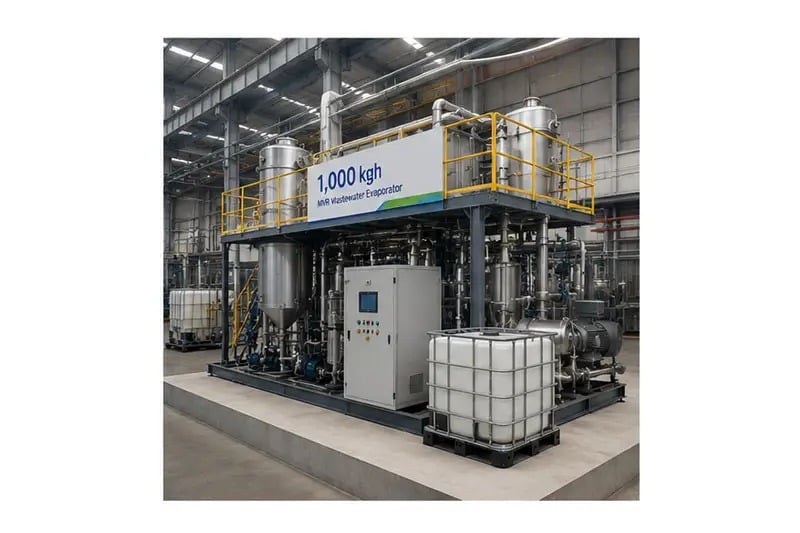
The performance of an evaporator crystallizer hinges on a single critical variable: residence time. Whether you operate a wastewater treatment facility, chemical processing plant, or salt recovery system, understanding residence time is essential to maximizing efficiency and product quality. Residence time determines how long liquid remains in the chamber, directly influencing crystal formation, separation quality, and overall system throughput. Overlooking this parameter leads to poor crystal growth, inconsistent product specifications, and reduced operational efficiency.
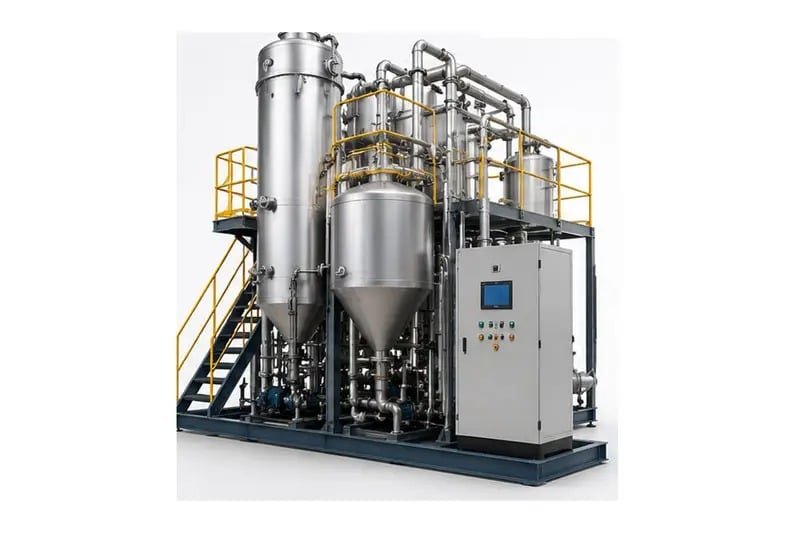
In industrial applications, residence time acts as the bridge between evaporation and crystallization. It provides the necessary window for molecules to organize into stable crystal structures while maintaining adequate throughput to meet production targets. The interplay between residence time and crystal growth determines whether your system produces valuable crystalline products or waste streams. Proper control of residence time eliminates guesswork and enables predictable, repeatable results that maximize both yield and quality.
How Residence Time Affects Crystal Growth
The Crystal Formation Timeline
Crystal growth within an evaporator crystallizer follows a predictable sequence that depends entirely on residence time. As the solution is heated and water evaporates, supersaturation builds. The longer molecules remain in the crystallization zone, the more time they have to form nucleation sites and build upon existing crystal lattices. Insufficient residence time prevents complete crystal development, resulting in fine, poorly formed crystals that are difficult to separate and recycle. Extended residence time allows larger, better-formed crystals to develop, improving downstream filtration and washing operations while enhancing product purity.
Nucleation and Growth Balance
The sweet spot for residence time balances nucleation with growth. Early in the residence time period, nucleation dominates as new crystal sites form rapidly. As residence time increases, growth mechanisms take over and crystals enlarge. If residence time is too brief, nucleation never fully completes and you harvest undersized crystals. If residence time extends too long without proper control, secondary nucleation or crystal agglomeration can degrade product uniformity. Experienced operators understand that crystal growth in an evaporator crystallizer responds to residence time duration as much as to temperature and cooling rate adjustments.
Managing Throughput While Maintaining Control
The Throughput-Quality Trade-off
Operating an evaporator crystallizer at maximum throughput tempts many facility managers, but residence time reveals an uncomfortable truth: speed and quality are not always compatible. Increasing feed rate reduces residence time, pushing more material through the system faster. However, shorter residence time compromises crystal growth, forcing you to choose between volume and specification compliance. Modern control strategies balance this tension by adjusting residence time dynamically. This ensures that throughput targets are met without sacrificing the crystal size, purity, or consistency that downstream processes require. The key is recognizing that residence time is not a constraint to eliminate but a variable to optimize.
Implementing Residence Time Control
Practical residence time control involves monitoring feed rate, chamber volume, and removal rate simultaneously. Most industrial evaporator crystallizer systems use level sensors to maintain target residence time automatically. When residence time falls below the minimum required for adequate crystal growth, the system reduces feed rate or increases the crystallizer chamber volume. Conversely, if residence time becomes excessive, operators increase removal rate to maintain throughput. This closed-loop approach prevents the common pitfall of guessing residence time based on intuition or rules of thumb. Real-time residence time adjustment transforms the evaporator crystallizer from a batch-dependent operation into a precise, controllable process that consistently delivers on production and quality commitments.
Optimizing Performance Across Operating Conditions
Seasonal and Load Variations
Industrial facilities rarely operate at constant conditions year-round. Feed composition, temperature, and pressure fluctuate based on source material quality, ambient conditions, and production schedules. These variations directly impact the optimal residence time required to maintain acceptable crystal growth. Winter cooling water availability differs from summer availability, altering crystallization kinetics. Feed salinity or concentration may vary, changing the evaporation rate and crystallizer behavior. An evaporator crystallizer designed for fixed residence time fails to adapt to these shifts, resulting in periods of poor crystal quality or insufficient throughput. Adaptive control strategies adjust residence time dynamically, maintaining crystal growth and throughput performance across the full range of operating conditions your facility encounters.
Predictive Performance Metrics
Once operators establish the relationship between residence time and crystal growth for their specific feed material and evaporator crystallizer configuration, they can predict performance outcomes. If current residence time produces crystals of target size and purity, reducing residence time by 10 percent will predictably degrade those metrics. Conversely, increasing residence time by 15 percent may not yield proportional quality improvements if growth is already saturated. Understanding these residence time response curves transforms operation from reactive troubleshooting into proactive management. Historical data on residence time, throughput, crystal size distribution, and product purity enables operators to forecast how changes to residence time will cascade through downstream processes. This predictive capability reduces trial-and-error adjustments and accelerates the path to optimal performance.
FAQ
What residence time should I target for my evaporator crystallizer?
The ideal residence time depends on feed composition, desired crystal size, throughput requirements, and the specific evaporator crystallizer design. Most industrial systems operate between 15 to 45 minutes, though specialty applications may require different ranges. The only reliable way to determine optimal residence time is to conduct controlled trials with your actual feed material and monitor crystal growth, size distribution, and purity across different residence time settings. Start by consulting your equipment manufacturer's recommendations, then refine based on your product specifications and facility constraints.
How does residence time impact energy consumption?
Longer residence time requires more heat input to maintain crystallization temperature and remove dissolved solids, increasing energy per unit of throughput. Shorter residence time reduces energy consumption per unit but compromises crystal quality and may require reprocessing defective material. An evaporator crystallizer optimized for residence time balances energy efficiency with product quality by finding the minimum residence time that meets specification. In some cases, slightly longer residence time that eliminates reprocessing and downstream problems actually improves total system energy efficiency despite higher evaporator energy per kilogram.
Can I adjust residence time without stopping the evaporator crystallizer?
Yes, residence time can be adjusted dynamically by changing feed rate, withdrawal rate, or crystallizer chamber level while the evaporator crystallizer operates continuously. Most modern systems include automated controls that modify these parameters to maintain target residence time. However, adjustments should be gradual to avoid shocking the crystallization process and degrading crystal quality. Larger jumps in residence time require careful monitoring and may briefly affect product specifications until the system reaches steady state with the new residence time value.

 EN