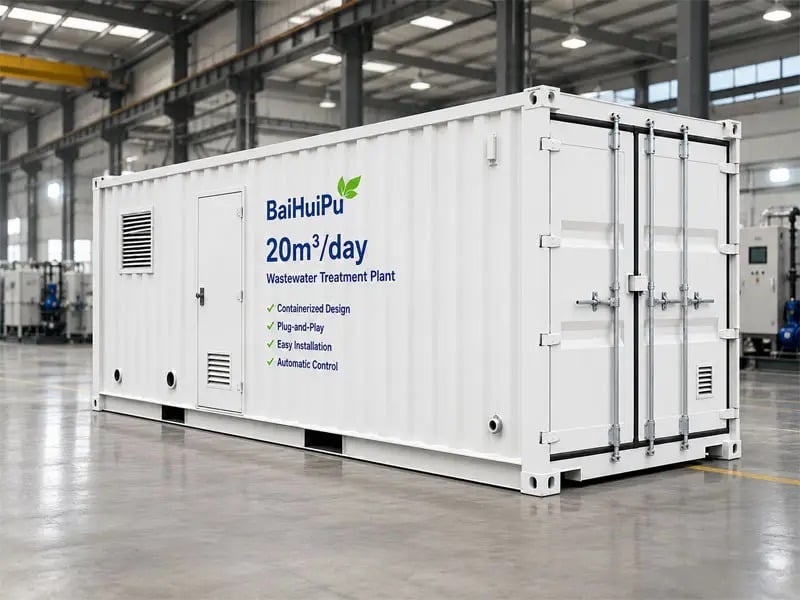
A factory acceptance test, or FAT, represents a critical checkpoint before a containerized wastewater treatment plant ships to the job site. This comprehensive validation ensures the system performs according to design specifications and regulatory requirements. The FAT protocol allows manufacturers, engineers, and clients to verify functionality in a controlled environment, significantly reducing installation delays and operational surprises once the plant reaches the facility.
Understanding what belongs in a FAT for containerized wastewater treatment systems prevents costly rework and compliance failures. The test scope encompasses mechanical, electrical, control, and operational elements that must work seamlessly. A well-structured FAT protects your investment, documents baseline performance, and establishes confidence before on-site installation begins.
Core Components of a Comprehensive FAT
Mechanical and Piping Verification
Piping integrity forms the foundation of containerized wastewater treatment performance. The FAT must verify that all pipe connections are leak-free under operating pressure, that materials match design specifications, and that pipe routing follows the approved layout. Visual inspection should confirm proper support, alignment, and clearance for maintenance access. Pressure tests on each major piping section validate welds, threaded connections, and valve seats before the system circulates actual wastewater.
Pump performance testing ensures flow rates and head pressures meet design targets. Technicians should operate the system at minimum, normal, and maximum loads while measuring discharge pressure, suction conditions, and vibration levels. The FAT must confirm that all isolation valves function smoothly and that bypass or recirculation piping operates as intended. Documentation of these baseline measurements provides a reference for future troubleshooting and preventive maintenance planning.
Mechanical System Function
Aeration equipment, clarifier mechanisms, and sludge handling systems must demonstrate reliable operation during FAT. Screen or pre-treatment devices should process synthetic or representative test material to confirm they remove solids effectively and do not clog. Settling tanks and clarification zones should achieve the expected solids separation within design detention times. For containerized wastewater treatment with biological processes, aeration capacity and dissolved oxygen delivery must meet design specifications measured under controlled test conditions.
Control Systems and Instrumentation Testing
SCADA and Controls Validation
Industrial controls form the operational nervous system of any containerized wastewater treatment installation. The FAT must test all programmable logic controller (PLC) sequences, human-machine interface (HMI) screens, and sensor calibration. Each control loop—level sensing, flow measurement, pH monitoring, dissolved oxygen feedback—should be exercised through its full operating range. Technicians verify that alarm thresholds trigger correctly, that manual override functions work properly, and that system shutdown sequences execute safely.
Safety interlocks deserve particular attention during controls testing. The FAT should confirm that high-level conditions activate appropriate pump shutdowns or bypass operations, that low-pressure alarms prevent dry-running, and that emergency stop buttons function instantly. Simulation of fault conditions—sensor failures, power loss, blocked discharge—validates the system's protective responses without risking equipment damage. Documentation of all control setpoints, alarm limits, and calibration values becomes the baseline for site commissioning and ongoing operation.
Instrumentation Calibration and Response
Every sensor and transmitter in a containerized wastewater treatment system must be bench-tested and calibrated before FAT. Flow meters should be verified against known reference volumes, pressure transmitters checked across their range, and pH probes confirmed with buffer solutions. Response time testing ensures that controls react appropriately to process changes rather than lagging behind actual conditions. The FAT must document all calibration certificates, setpoint confirmations, and sensor accuracy verifications for regulatory compliance and future maintenance reference.
Performance Testing and Operational Scenarios
Startup and Shutdown Sequences
A containerized wastewater treatment FAT must include multiple complete startup cycles to confirm smooth equipment sequencing and control logic. The system should fill properly, establish stable flows, activate aeration or treatment processes in the correct order, and reach steady-state operation. The FAT should also exercise normal shutdown procedures, emergency stops, and restart capabilities. These operational rehearsals in a factory environment reveal any timing conflicts, valve sequencing issues, or control logic gaps before the plant operates at a client facility.
Testing at minimum load, design flow, and peak load conditions reveals how the containerized wastewater treatment system responds to real-world demand variations. Flow stability, treatment effectiveness, and control system responsiveness should remain consistent across this operating envelope. The FAT provides confidence that the system will handle seasonal demand swings, surge flows, and idling periods without operational problems or control instability.
Piping and Component Stress Testing
Extended operation during FAT—often 24 to 48 hours of continuous run—reveals leaks, vibration issues, and component fatigue that might not appear during brief manual checks. Piping connections and valve seats that seem tight during initial assembly sometimes weep slightly under sustained pressure and temperature cycling. Pump bearing temperatures, motor current draw, and equipment noise levels should stabilize within expected ranges. Any abnormal conditions discovered during extended FAT testing are corrected before the containerized wastewater treatment plant ships, avoiding emergency repairs and downtime at the installation site.
Documentation and Quality Assurance
FAT Records and Sign-Off
Comprehensive FAT documentation serves as both a quality assurance record and a reference manual for site installation and commissioning. Test reports must include initial conditions, test procedures, observed results, any deviations or corrective actions taken, and final acceptance signatures. Photographs and videos of equipment operation, control screens, and piping assemblies provide visual evidence of compliance. All calibration certificates, sensor verifications, and mechanical test results—pressure tests, flow measurements, vibration readings—belong in the FAT package.
Preparation for Site Commissioning
A thorough FAT significantly streamlines on-site commissioning of the containerized wastewater treatment system. Site technicians can reference FAT data to confirm that equipment arrived in working condition, that installation has not introduced damage or misalignment, and that baseline performance has been preserved. Any deviations between FAT results and initial site operation are immediately visible, helping field teams diagnose integration issues rather than spending time troubleshooting equipment that was already validated. This efficiency reduces commissioning time, operator training duration, and cost overruns.
FAQ
What is the typical duration of a FAT for containerized wastewater treatment?
A FAT typically spans 3 to 5 working days, though complex systems with extensive testing and controls may require a week or more. The schedule includes equipment preparation, system fill and pressurization, controls calibration, extended operational runs at various loads, and comprehensive documentation review. Coordination between the manufacturer, design engineer, and client ensures all stakeholders can attend and sign off on results.
How does FAT differ from SAT or site acceptance testing?
FAT occurs at the factory before shipment and focuses on validating that equipment functions according to design in a controlled environment. SAT happens after installation at the actual site and verifies that the containerized wastewater treatment system integrates properly with site utilities, influent sources, and discharge routes. Both are essential—FAT catches manufacturing issues, while SAT confirms installation quality and operational readiness under real-world conditions.
Can a FAT identify all potential problems before site installation?
A FAT cannot predict every site-specific condition, such as unusual influent characteristics, extreme climate effects, or utility limitations at the facility. However, it validates that the containerized wastewater treatment system functions reliably under design parameters and has no manufacturing defects. This significantly reduces risk and provides a strong foundation for on-site performance, even though site commissioning remains essential to confirm operation within the actual deployment environment.

 EN