Industries requiring ultrapure water demand advanced treatment solutions that combine multiple purification stages to achieve the lowest possible contaminant levels. An ultrapure water purification system integrating reverse osmosis and electrodeionization represents the gold standard for pharmaceutical manufacturing, semiconductor production, power generation, and laboratory applications where even trace mineral content can compromise product quality or equipment performance.
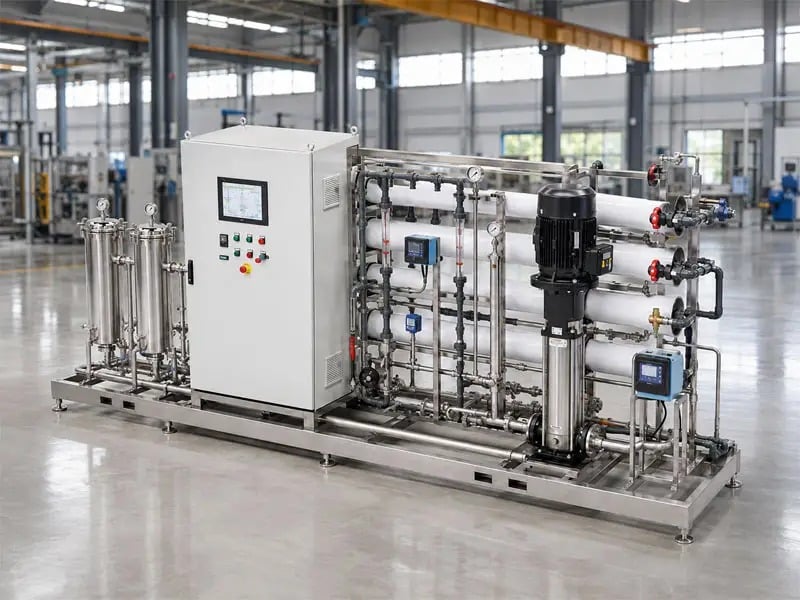
The combination of RO and EDI technology delivers conductivity levels below 1 microsiemens per centimeter and removes dissolved solids, ions, and organic compounds that single-stage systems cannot address. Understanding how these technologies work together, their performance characteristics, and their role in meeting industry-specific purity standards is essential for operations managers and engineering teams planning water treatment infrastructure.
Understanding RO Technology in Ultrapure Water Production
How Reverse Osmosis Removes Contaminants
Reverse osmosis operates by forcing pressurized feedwater across a semipermeable membrane, separating dissolved salts, minerals, and organic molecules from pure water. In an ultrapure water purification system, RO serves as the primary filtration stage, removing approximately 95 to 99 percent of total dissolved solids and most monovalent and divalent ions. The membrane pore size, typically 0.0001 microns, blocks virtually all bacteria, viruses, and colloidal particles while allowing water molecules to pass through.
RO system design requires careful consideration of feed water quality, operating pressure, and membrane material. Pretreatment using sediment filters and activated carbon protects the high-purity membranes from fouling and extends their operational lifespan. For semiconductor and pharmaceutical applications, membrane rejection rates directly influence downstream treatment requirements and final product purity.
Performance Metrics and Operational Factors
The effectiveness of RO in an ultrapure water purification system depends on feedwater temperature, pH, and mineral composition. Higher temperatures improve membrane permeability but reduce rejection rates slightly, while pH adjustment optimizes ion separation for specific mineral types. Operating pressure typically ranges from 150 to 300 psi for municipal water sources, with higher pressures needed for brackish or seawater applications.
Monitoring permeate conductivity and flow rate indicates membrane health and fouling progression. When high-purity water output degrades, membrane cleaning or replacement becomes necessary to maintain specification compliance.
The Role of EDI in Achieving High Purity Standards
Electrodeionization Process and Ion Removal
Electrodeionization, or EDI, applies electrical potential to ion exchange resin beds within a pressurized chamber, continuously removing residual ions that RO cannot eliminate. Unlike traditional mixed-bed deionization, EDI regenerates resin automatically during operation without chemical regeneration cycles, making it ideal for high-purity applications demanding sustained performance. In an ultrapure water purification system, EDI polishes RO permeate to achieve conductivity below 0.5 microsiemens per centimeter and removes silica, boron, and other weakly ionized compounds.
The electrical field drives cations and anions through separate ion exchange compartments toward their respective electrodes, while a middle chamber regenerates the resin continuously. This design eliminates downtime for chemical regeneration and prevents contamination from regenerant chemicals.
Integration with RO for Complete Purification
When RO and EDI work together in an ultrapure water purification system, they create a synergistic purification cascade. RO reduces the ionic load entering the EDI module, extending resin life and improving energy efficiency. EDI then removes the remaining dissolved solids that RO allows to pass, achieving the high-purity specification demanded by critical applications. This two-stage approach is more cost-effective and reliable than using EDI alone, which would require frequent resin replacement and higher electrical input.
Feedwater conductivity below 5 microsiemens per centimeter entering the EDI module ensures optimal performance and minimizes electrode fouling, making proper RO pretreatment essential for system longevity.
Industrial Applications and High Purity Requirements
Semiconductor and Microelectronics Manufacturing
Semiconductor fabrication demands ultrapure water with conductivity below 0.1 microsiemens per centimeter and minimal particle contamination to prevent defects during photolithography, etching, and wafer cleaning processes. An ultrapure water purification system combining RO and EDI meets these stringent requirements consistently, supporting production efficiency and yield rates. Even trace minerals or organic contaminants can interfere with photoresist chemistry or cause corrosion in precision equipment.
EDI technology proves particularly valuable in semiconductor applications because it eliminates the risk of chemical residues from traditional ion exchange regeneration, which could introduce unwanted contaminants into high-purity water batches.
Pharmaceutical and Biopharmaceutical Production
Pharmaceutical manufacturers require high-purity water for formulation, cleaning, and equipment sterilization, with regulatory compliance to USP and EP standards. An ultrapure water purification system delivers water meeting Type I specifications, with conductivity and TOC levels within acceptable limits for parenteral products and sterile injections. RO removes the bulk of minerals and endotoxins, while EDI polishes the output to meet the strictest purity benchmarks.
Continuous monitoring and system validation ensure that pharmaceutical operations maintain consistent product quality and regulatory compliance throughout production campaigns.
Power Generation and Laboratory Applications
Power plants using high-pressure boilers require ultrapure water to prevent scaling, corrosion, and equipment failure. Analytical laboratories performing trace element analysis or high-performance liquid chromatography need high-purity water to avoid interference and ensure accurate results. Both sectors depend on integrated RO and EDI systems to achieve the necessary purity levels reliably and economically.
FAQ
Why is EDI necessary if RO already removes most contaminants?
Although RO removes 95 to 99 percent of dissolved solids, trace ions and organic compounds remain in the permeate. EDI technology eliminates these residual contaminants through continuous ion exchange and electrical regeneration, achieving the ultra-low conductivity and TOC levels required by semiconductor, pharmaceutical, and laboratory applications. Without EDI polishing, many critical industries would fail to meet their high-purity specifications.
How often does an ultrapure water purification system require maintenance?
RO membranes typically require cleaning every 3 to 6 months depending on feedwater quality and usage patterns, with replacement recommended every 2 to 3 years. EDI modules need less frequent intervention but benefit from periodic inspection and occasional cleaning to maintain electrical efficiency. System performance monitoring through conductivity and flow rate measurements guides maintenance scheduling and prevents unexpected downtime.
Can an ultrapure water purification system be scaled for different production volumes?
Yes, RO and EDI systems scale effectively across applications ranging from laboratory benchtop units producing a few gallons daily to industrial systems delivering hundreds of gallons per minute. Modular design allows operators to add RO stages or parallel EDI modules to increase capacity or improve efficiency. Proper design ensures that scaling maintains high-purity performance regardless of production volume.

 EN






