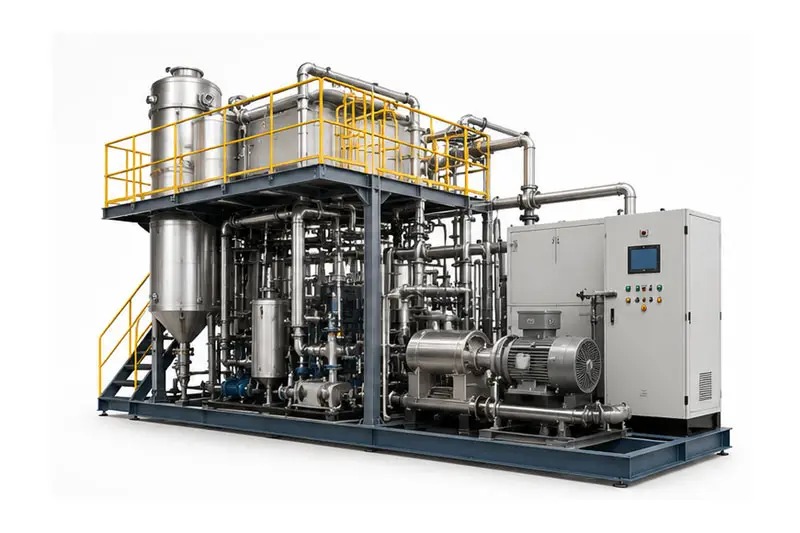
Mechanical vapor recompression, or mvr water treatment, has become a cornerstone technology in modern industrial wastewater management. As regulatory pressure intensifies and freshwater scarcity deepens, organizations are turning to advanced evaporation systems to transform contaminated water into recoverable resources. The question isn't whether evaporation belongs in your water recovery strategy—it's understanding exactly where and how it fits within your broader sustainability goals.
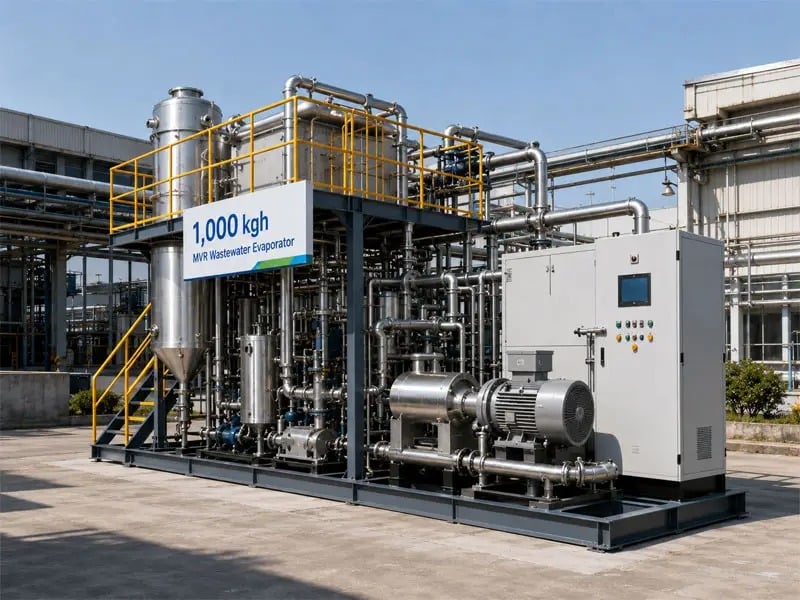
Evaporation sits at the heart of water recovery projects because it separates clean water vapor from dissolved solids and contaminants. When integrated into a zero liquid discharge or ZLD framework, evaporation enables concentration of waste streams to their maximum recoverable point. This positions MVR technology not as a standalone solution, but as a critical link between primary treatment stages and final water reuse or disposal pathways.
How Evaporation Drives Concentration and Recovery
The Separation Mechanism in MVR Systems
MVR water treatment works by heating wastewater to its boiling point, causing water to evaporate while solids remain behind. The evaporated vapor is then compressed mechanically, raising its temperature and saturation pressure so it can serve as the heat source for the next batch of incoming feed. This closed-loop approach eliminates the need for external steam, drastically reducing energy costs compared to traditional evaporation methods.
The concentration process is where water recovery truly gains momentum. As water evaporates, the dissolved and suspended solids become increasingly concentrated in the remaining liquid. This concentrated stream can then be further processed, crystallized, or disposed of more safely and compliantly. Simultaneously, the evaporated distillate emerges as pure water ready for reuse.
Energy Efficiency in Water Recovery Projects
One reason MVR technology dominates water recovery and ZLD applications is its superior energy profile. By recycling latent heat internally rather than venting it to atmosphere, MVR systems consume 40–60 percent less energy than conventional evaporators. For water recovery projects operating continuously, this efficiency translates into lower operational costs and faster payback periods, making aggressive reuse targets economically viable.
Energy efficiency also matters because it determines whether a water recovery project can achieve its concentration goals within budget constraints. When energy costs are lower, operators can run longer evaporation cycles, pushing concentration levels higher and maximizing the volume of water available for reuse within the facility.
Evaporation's Role in Zero Liquid Discharge and Reuse Goals
Fitting Evaporation into ZLD Strategies
Zero liquid discharge projects are structured in layers, and evaporation occupies the critical middle stage. Primary treatment removes larger particles and oils; secondary biological systems reduce organic load; tertiary membrane filtration polishes the water further. At this point, a challenging concentrate stream remains—too contaminated for direct discharge but too dilute to crystallize efficiently. MVR water treatment bridges this gap by concentrating the stream to the point where crystallization, precipitation, or other terminal treatment becomes practical.
Without evaporation, achieving ZLD becomes prohibitively expensive or technically infeasible. The concentrate stream must go somewhere, and landfilling it indefinitely contradicts the zero discharge objective. Evaporation transforms this problem stream into an asset: purified distillate for reuse and a compact concentrate for controlled handling or resource recovery.
Water Reuse Pathways After Evaporation
Distillate from MVR systems typically meets or exceeds non-potable reuse standards. In industrial applications, this recovered water can be returned to cooling towers, process washdowns, boiler feed, or irrigation—depending on the facility's operational structure and regulatory environment. Water recovery projects that integrate evaporation report reuse rates of 60–85 percent of total wastewater volume, a dramatic improvement over facilities relying on membrane filtration alone.
The concentration aspect is equally valuable for reuse planning. By concentrating waste streams through evaporation, facilities reduce the physical volume requiring disposal or further treatment. This smaller, more stable concentrate stream is easier to transport, less expensive to handle, and more likely to qualify for industrial resource recovery options like salt crystallization or metal reclamation.
Practical Integration and Project Considerations
When to Deploy MVR in Water Recovery Workflows
MVR water treatment excels in scenarios where feed salinity, organic content, or mixed contaminants make membrane-only treatment ineffective. If your water recovery project produces a persistent concentrate stream after reverse osmosis, ultrafiltration, or biological treatment, evaporation becomes essential. Similarly, facilities targeting aggressive ZLD or reuse mandates benefit most from MVR's ability to push concentration to extreme levels while recovering maximum distillate volume.
Project timelines also matter. Facilities with existing thermal or steam infrastructure may adapt quickly to evaporation, while greenfield projects can optimize MVR placement from the start. The concentration capacity of your evaporator should match your feed flow rate and target recovery volume to ensure the system neither oversizes nor undersizes your water recovery goals.
Technical Fit and Operational Reality
Evaporation is not universally appropriate for every waste stream. Highly fouling liquids, those with oils or precipitating salts, may require pre-treatment before feeding an MVR system to prevent scaling and downtime. Operators must also account for non-volatile compounds—substances that don't evaporate but concentrate alongside salts. Understanding your feed chemistry determines whether evaporation alone completes water recovery or whether post-evaporation crystallization, centrifugation, or drying is necessary.
Maintenance and monitoring elevate evaporation from an add-on technology to a reliable backbone of water recovery infrastructure. Regular descaling, tube inspection, and vapor quality monitoring ensure sustained concentration performance and distillate purity. Facilities treating their MVR system as a strategic asset rather than a commodity equipment purchase see the longest operational life and highest water recovery returns.
FAQ
What percentage of industrial wastewater can be recovered using MVR water treatment?
Recovery rates depend on feed quality and the evaporation target. Most industrial water recovery projects achieve 60–85 percent recapture of incoming wastewater through MVR, with the remainder forming a concentrated residue. ZLD facilities push recovery even higher by crystallizing or solidifying the concentrate, reaching near-total resource recovery and near-zero liquid discharge.
How does evaporation differ from other concentration methods in water recovery?
Evaporation via MVR uses thermal energy to physically separate water from dissolved solids, while membrane-based concentration uses pressure to filter particles. Evaporation is more effective for salt-heavy or thermally stable waste, whereas membranes work better for particulates and organic molecules. Many advanced water recovery systems combine both technologies—membrane pre-concentration followed by MVR evaporation to achieve ZLD targets cost-effectively.
Is MVR water treatment suitable for all types of industrial wastewater?
Most industrial waste streams benefit from MVR treatment, but highly fouling, corrosive, or explosive vapor environments require careful equipment selection and pre-treatment. Food processing, chemical manufacturing, metal finishing, and pharmaceutical wastewater are common applications. Pre-screening your feed chemistry ensures the MVR system operates reliably and delivers consistent water recovery and concentration performance without frequent shutdowns.

 EN