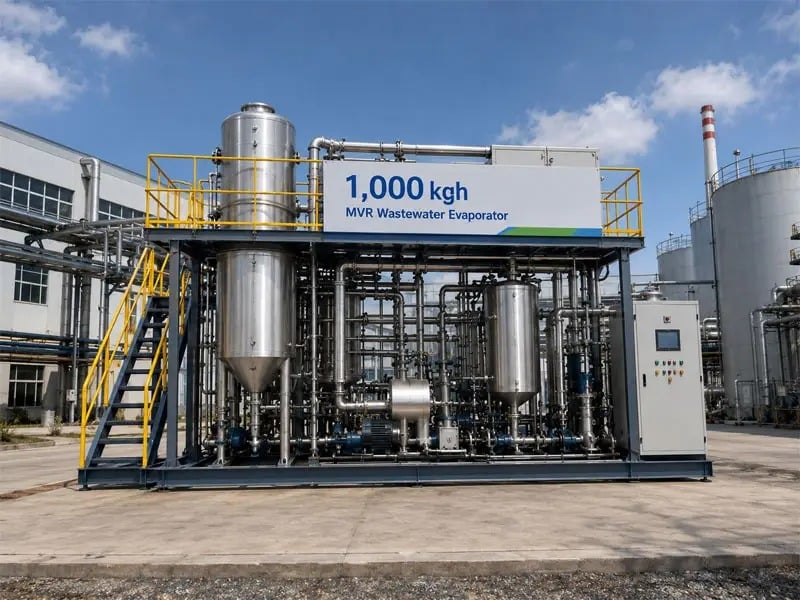
Selecting the right mvr evaporator for your industrial wastewater treatment requires understanding far more than the nameplate capacity printed on equipment datasheets. Many operators rely solely on manufacturer specifications, only to discover that actual energy demand during operation differs significantly from expectations. This misalignment between theoretical capacity and real-world performance creates operational inefficiencies, unexpected utility costs, and potential system failures. To design and operate an effective evaporation system, you must account for multiple variables that influence how much energy your equipment will actually consume.
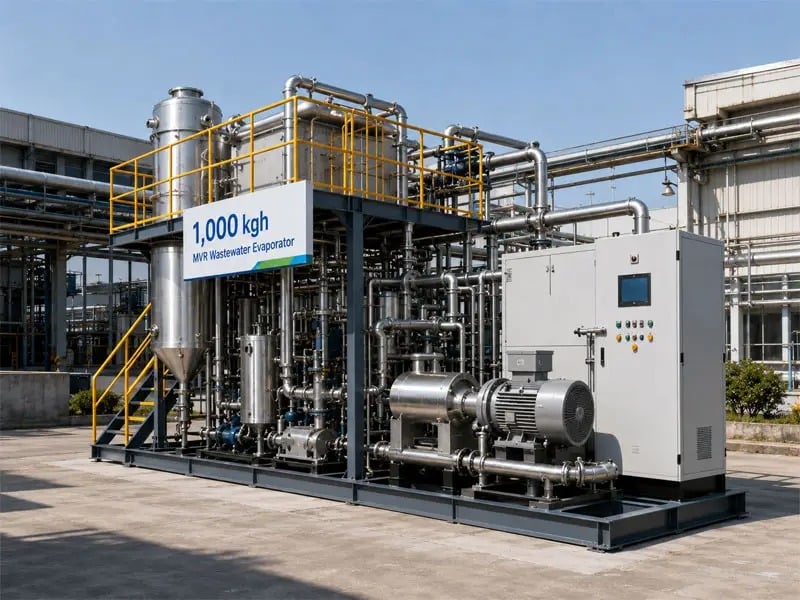
Estimating energy demand accurately requires a systematic approach that moves beyond generic specifications. The actual energy consumption of an mvr evaporator depends on the specific characteristics of your feed stream, the operating conditions you maintain, and how the system interacts with your facility's infrastructure. Feed quality, temperature variables, and realistic capacity utilization all play critical roles in determining whether your equipment will operate efficiently or struggle under unexpected loads. Understanding these factors allows you to predict energy demand with confidence and make informed decisions about equipment sizing, operational strategies, and long-term cost management.
Understanding Feed Quality Impact on Energy Demand
Characteristics That Drive Energy Requirements
Feed quality fundamentally determines how hard your mvr evaporator must work. When you evaluate feed quality, you assess factors such as total dissolved solids (TDS), suspended solids concentration, organic content, and thermal properties of the liquid being processed. A stream with high TDS requires more energy to concentrate because more dissolved material must be separated from the water phase. Similarly, feed with elevated suspended solids may require additional pretreatment or filtration, effectively increasing the overall energy demand across your treatment system. The chemical composition of your feed directly influences the energy needed for phase separation and vapor condensation.
Scaling and Fouling Considerations
Scaling and fouling reduce the effective heat transfer efficiency of your mvr evaporator over time, causing energy demand to rise continuously throughout operating cycles. As mineral deposits accumulate on heat exchanger surfaces, the equipment must work harder to achieve the same evaporation rate. Feed quality that promotes rapid scaling—such as streams with high calcium, magnesium, or silica content—will drive your energy consumption upward significantly. Estimating realistic energy demand requires accounting for fouling progression, not just initial clean-surface performance. Regular maintenance intervals and feed pretreatment strategies can help minimize this energy creep, but neglecting fouling effects in your energy estimate will lead to substantial operational surprises.
Temperature Dynamics and Operating Conditions
Inlet Temperature and Evaporation Efficiency
The temperature at which feed enters your mvr evaporator directly influences energy demand throughout the concentration process. If your feed arrives at ambient temperature, the system must provide additional energy to raise it to the operating temperature needed for effective evaporation. Conversely, if you can integrate preheating from waste heat sources or use hot feed from preceding treatment stages, your energy demand drops substantially. The temperature difference between the feed inlet and the target evaporation temperature represents a direct energy cost. Many facilities overlook this variable when estimating energy requirements, assuming nameplate specifications account for average conditions. In reality, your specific feed temperature profile may differ from manufacturer test conditions, resulting in higher or lower actual energy demand depending on your facility layout and seasonal variations.
Condenser Temperature and System Efficiency
The temperature at which your mvr evaporator's condenser operates affects both energy demand and overall system efficiency. If your facility has cold water sources readily available, condensing vapor efficiently keeps the temperature differential high, reducing compressor workload and lowering energy demand. Conversely, if cooling water is warm or limited in supply, the condenser cannot reject heat efficiently, forcing the compressor to work harder. This interplay between evaporator temperature and condenser temperature creates a critical relationship that directly impacts your energy consumption. When estimating energy demand, you must account for the realistic cooling capacity available at your site, not assume ideal laboratory conditions. Temperature management across the entire mvr evaporator system represents one of the most powerful levers for controlling energy costs.
Capacity Utilization and Real-World Load Profiles
Operating Point Versus Nameplate Rating
Nameplate capacity represents the maximum throughput under ideal laboratory conditions, but your facility rarely operates at that theoretical peak. Most industrial processes run at partial load, where the mvr evaporator consumes proportionally less energy than nameplate specifications suggest. However, some facilities operate their equipment above nameplate capacity during peak production periods, incurring higher energy demand than anticipated. Estimating realistic energy demand requires you to identify your typical operating point—the percentage of nameplate capacity you actually maintain during normal production. If your feed volume fluctuates seasonally, your energy demand profile will vary accordingly. Equipment manufacturers often provide performance curves showing energy consumption at different capacity levels, but you must match these curves to your specific operational patterns.
Accounting for Part-Load Efficiency
Many mvr evaporator systems do not scale linearly when operating at reduced capacity. Some equipment exhibits diminished efficiency at partial loads because compressors and circulation systems consume energy regardless of throughput volume. Other systems maintain relatively flat energy consumption across a wide operating range, meaning your energy demand per unit of product remains constant. Understanding your equipment's efficiency profile across the capacity range you actually use is essential for accurate energy estimation. If your facility processes 300 tons per day but your equipment has a 500-ton nameplate capacity, running at 60 percent utilization will not consume 60 percent of the nameplate energy demand. Actual consumption depends on your specific equipment design, control systems, and how effectively the system manages partial-load operation. This distinction between proportional and non-proportional energy consumption can mean substantial cost differences over the equipment's operational life.
FAQ
How much energy does an mvr evaporator typically consume per unit of feed processed?
Energy demand for an mvr evaporator typically ranges from 40 to 80 kilowatt-hours per ton of water evaporated, depending on your specific feed quality, temperature conditions, and capacity utilization rate. This figure serves as a rough guideline, but your actual consumption will depend heavily on how well you optimize feed pretreatment, leverage available waste heat, and maintain clean heat transfer surfaces. To determine your precise energy demand, collect performance data from similar treatment systems processing comparable feed streams, or conduct pilot testing with representative samples from your specific wastewater.
What role does feed quality play in determining energy demand for concentration?
Feed quality affects energy demand through multiple pathways: higher dissolved solids increase the energy needed for separation, suspended solids may require pretreatment adding system energy, and scaling-prone minerals accumulate on surfaces, forcing your mvr evaporator to work harder over time. As feed quality degrades or becomes more variable, your energy demand typically increases nonlinearly. Implementing robust feed pretreatment and choosing appropriate feed quality thresholds for your equipment helps minimize unexpected energy consumption and maintains predictable operating costs.
Can temperature management reduce the energy demand of an mvr evaporator system?
Yes, effective temperature management is one of the most powerful tools for controlling energy demand across your mvr evaporator installation. Preheating feed using waste heat sources, optimizing condenser cooling water supply, and maintaining proper thermal integration with your facility's broader energy infrastructure can reduce overall energy demand by 15 to 30 percent compared to baseline conditions. Careful site-specific design and commissioning focused on temperature optimization will directly lower your operating costs and improve the financial return on your equipment investment.

 EN