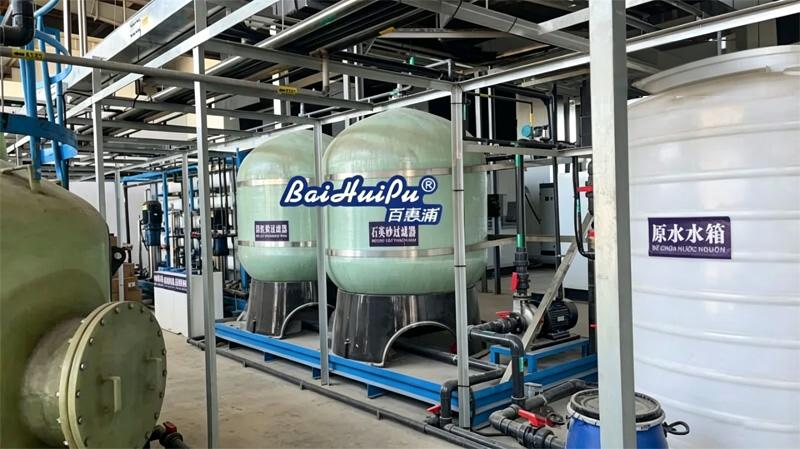
A 6 T/H ultrapure water solution featuring pretreatment, two-pass RO, EDI, and polishing resin, delivering 18 MΩ·cm ultrapure water for lithium iron phosphate (LFP) battery manufacturing in Vietnam with stable, fully automated operation.
Customer Profile
The customer is one of the world's few battery manufacturers with a fully integrated industrial chain, covering:
- Mineral resource development
- Battery material production
- Battery cell manufacturing
- Energy storage applications
- Battery recycling
Its vertically integrated manufacturing model enables complete control over product quality throughout the battery value chain.
In a previous phase, Baihuipu supplied the wastewater treatment system for this facility. This project represents the second phase, providing a complete ultrapure water production system for battery manufacturing.
Technical Specifications
System Capacity
6 T/H Ultrapure Water Production System
Main Process
Raw Water → Pretreatment → First-Pass Reverse Osmosis (RO) → Second-Pass Reverse Osmosis (RO) → Electrodeionization (EDI) → Polishing Resin → Ultrapure Water Tank
Water Quality
- Product water resistivity: ≥18 MΩ·cm
- Designed to meet electronic-grade ultrapure water requirements for lithium battery manufacturing
Design Features
- Full stainless steel process equipment
- Stainless steel and PVC piping installation
- EDI combined with polishing resin for dual purification assurance
- Nitrogen blanketing on ultrapure water storage to prevent atmospheric contamination
- Stable operation under continuous production conditions
- Winter production capacity maintained at ≥4 T/H
Project Background
To improve battery quality while reducing production costs, the customer decided to build a dedicated electronic-grade ultrapure water system for its lithium iron phosphate (LFP) battery manufacturing facility in Vietnam.
Based on the customer's production water demand and overall project requirements, Baihuipu engineered a customized ultrapure water solution capable of continuously supplying high-quality process water for battery production.
The system integrates pretreatment, two-pass reverse osmosis, EDI purification, and polishing resin technology to consistently achieve a product water resistivity of 18 MΩ·cm or higher, meeting the stringent water quality requirements of lithium battery manufacturing.
Process Description
Raw water first enters the pretreatment system, where suspended solids, chlorine, hardness, and other impurities are removed to protect downstream membrane equipment.
The pretreated water then passes through a two-pass reverse osmosis system, significantly reducing dissolved salts, organic contaminants, and colloidal particles.
Following RO treatment, the water enters the EDI (Electrodeionization) system, where high-voltage electrodes continuously remove ionized impurities without the need for conventional chemical regeneration.
The EDI process is complemented by a polishing resin unit, providing an additional purification stage to ensure consistently high water quality. Ion exchange resin accelerates the migration and removal of residual charged ions under the electric field, enabling the production of electronic-grade ultrapure water.
The final water quality depends primarily on two key factors:
- The performance and quality of the ion exchange resin.
- The ion exchange efficiency between water and the polishing resin.
To maintain stable water quality after production, the ultrapure water storage system is protected by nitrogen blanketing, effectively preventing carbon dioxide and airborne contaminants from entering the storage tank and maintaining consistently high resistivity.
Project Performance
The complete ultrapure water system has demonstrated excellent operational stability since commissioning.
Key project results include:
1. High-Purity Water Quality
The system consistently produces ultrapure water with a resistivity exceeding 18 MΩ·cm, fully meeting the water quality requirements for lithium battery manufacturing.
In addition, particulate contamination is maintained at extremely low levels, while microbial growth is effectively controlled to satisfy electronic-grade water standards.
2. Lower Operating Costs
By utilizing advanced membrane separation and EDI technology, the project significantly improves water recovery while reducing wastewater generation.
Optimized system design minimizes energy consumption and chemical usage, lowering the customer's long-term operating costs.
3. Reliable Automated Operation
The entire system features a high level of automation with intelligent online monitoring and control.
Real-time monitoring of water quality and equipment operating conditions ensures safe, reliable, and continuous operation while minimizing manual intervention.
Project Advantages
Compared with conventional ultrapure water production systems, Baihuipu's integrated solution offers several important advantages:
- Continuous production of electronic-grade ultrapure water
- Product water resistivity consistently above 18 MΩ·cm
- Two-pass RO + EDI + polishing resin for maximum purification reliability
- Nitrogen protection to maintain stable ultrapure water quality
- Reduced initial capital investment
- Smaller equipment footprint
- Lower operating energy consumption
- Simplified operation and maintenance
- Long-term stable performance for lithium battery manufacturing
The successful implementation of this project not only provides the customer with a reliable, around‑the‑clock supply of high‑quality ultrapure water—consistently meeting resistivity >18 MΩ·cm and strict TOC limits—but also significantly improves overall production efficiency through fully automated system controls and real‑time monitoring. In addition, the optimized membrane and EDI configuration effectively reduces chemical consumption and energy usage, thereby lowering operating costs by approximately 15% while supporting the stable, high‑yield manufacture of premium lithium iron phosphate batteries with enhanced electrochemical performance.
The customer expressed high satisfaction with both the overall system performance—particularly its steady output and low maintenance demands—and Baihuipu's engineering quality, installation workmanship, and on‑site project management, which were executed on schedule with minimal disruption to existing operations. This successful collaboration further demonstrates Baihuipu's proven expertise in providing turnkey ultrapure water solutions tailored to the stringent requirements of the global lithium battery industry, reinforcing our position as a trusted partner for large‑scale production facilities worldwide.

 EN