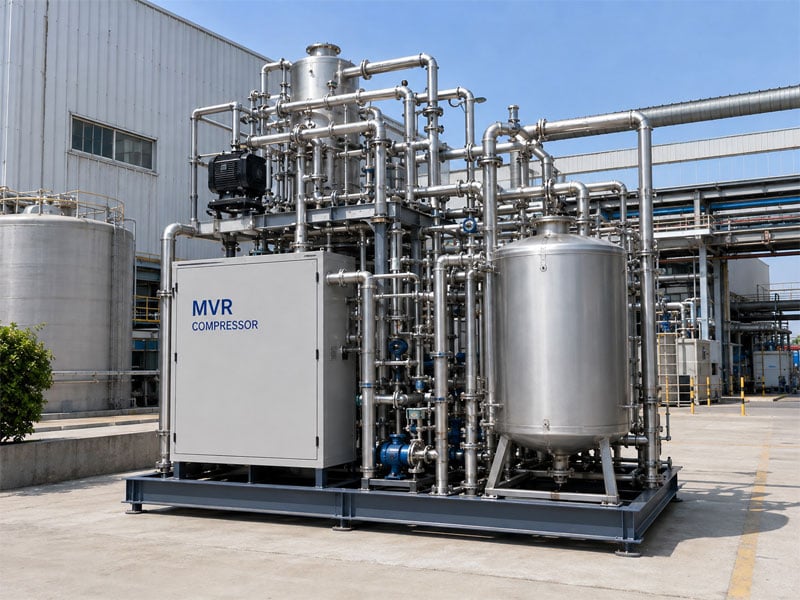
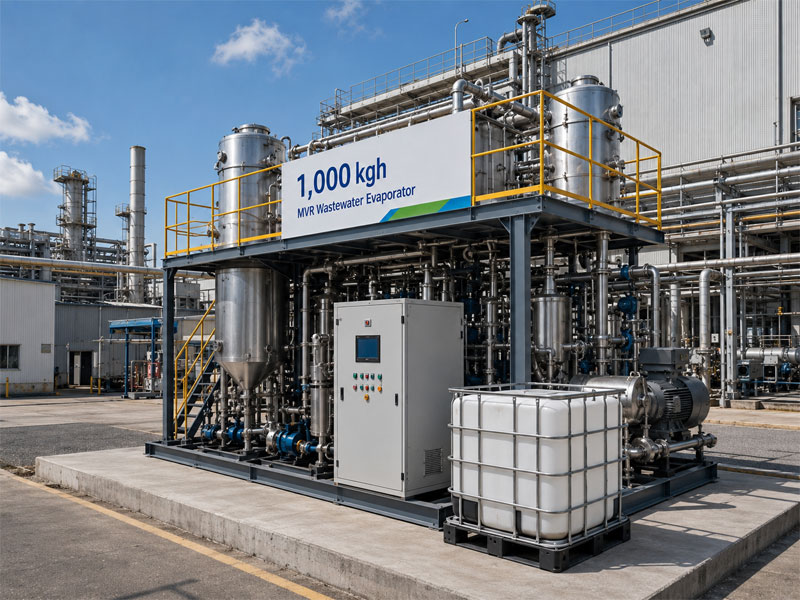
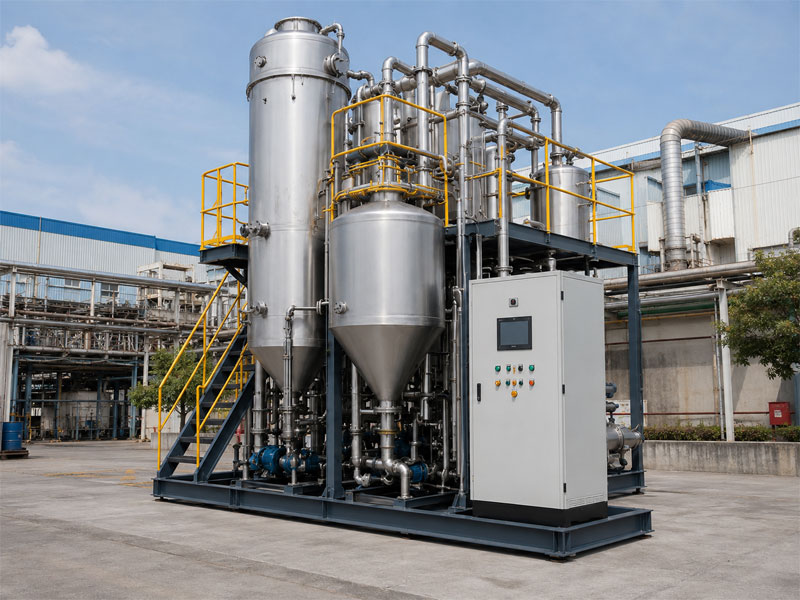
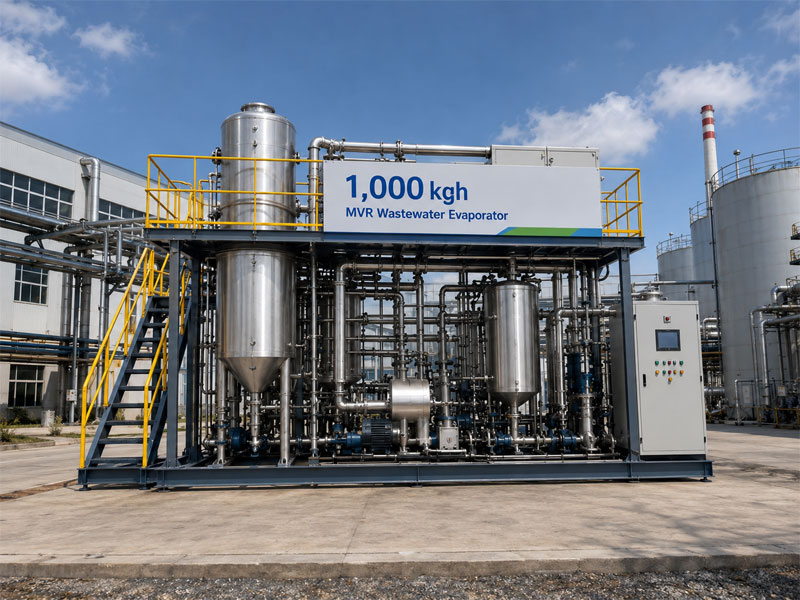
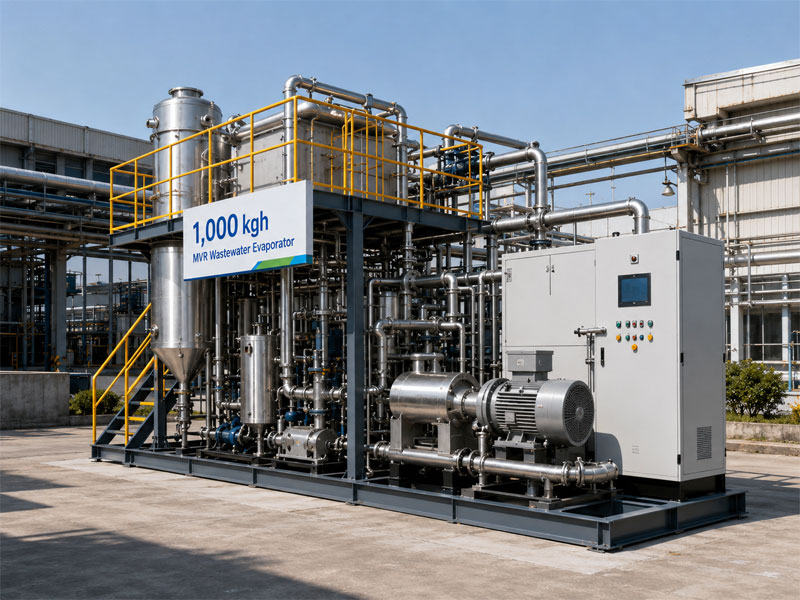
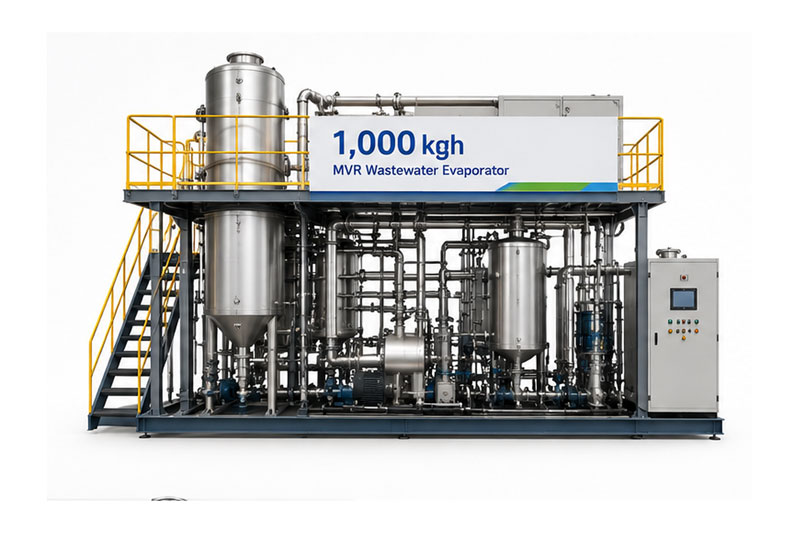
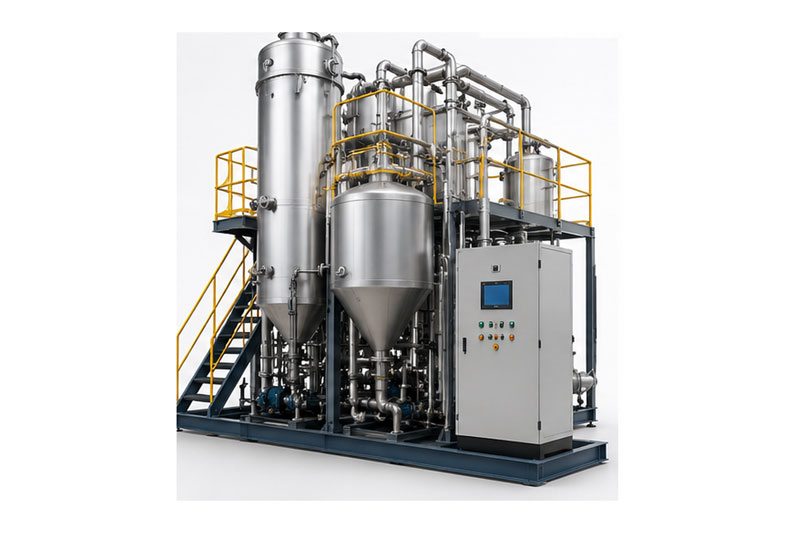
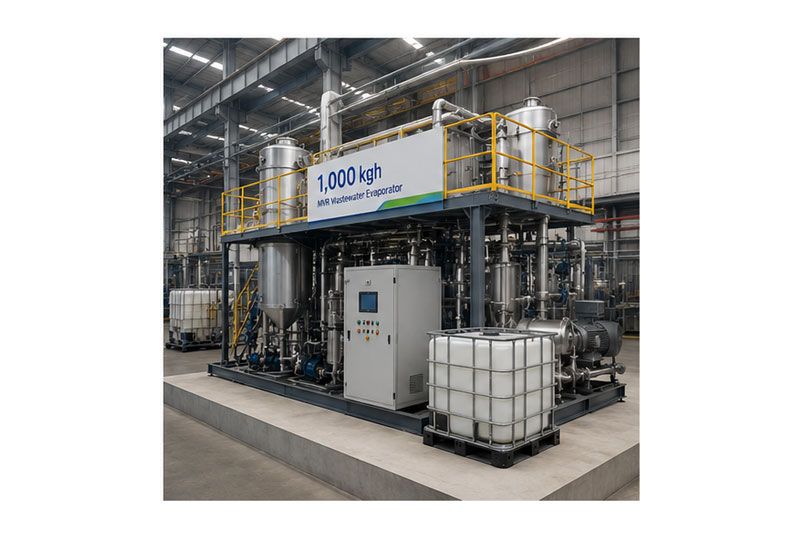
1,000 kg/h MVR Wastewater Evaporator
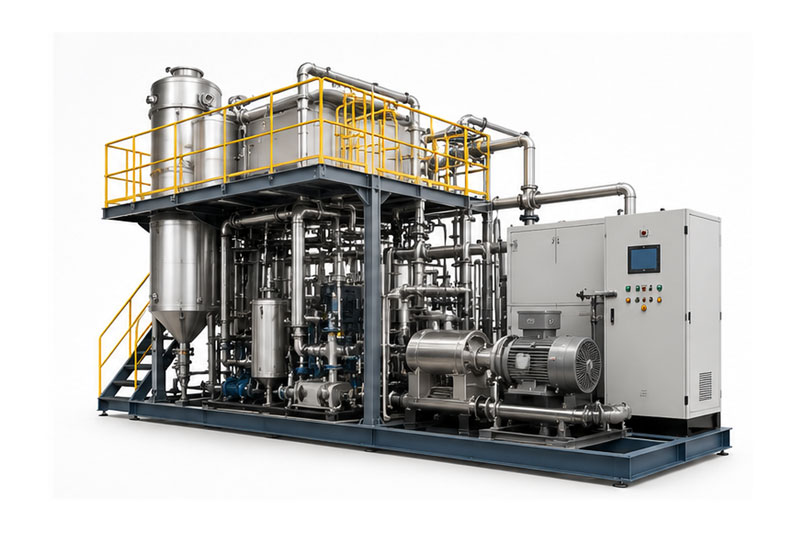
The 1,000 kg/h MVR Wastewater Evaporator is designed for continuous industrial concentration projects where stable throughput, energy control, and long-term operating value matter. As an MVR wastewater evaporator, it uses Mechanical Vapor Recompression to recover the latent heat contained in secondary vapor and reuse that heat inside the same system. In a wastewater evaporation system, this means the process does not need to depend on large amounts of fresh steam during normal operation, which is one of the main reasons buyers consider an MVR wastewater evaporator for continuous production lines.
In practical use, the 1,000 kg/h MVR Wastewater Evaporator is often selected for high-salinity wastewater streams that require reliable volume reduction before discharge, further treatment, or salt recovery. The system is suitable for applications in new-energy manufacturing, battery materials, chemicals, electroplating, pharmaceuticals, metal finishing, and other industrial processes that produce difficult wastewater. Because the MVR wastewater evaporator can be configured for different feed conditions, it is also a strong choice for projects that need a wastewater evaporation system tailored to corrosion resistance, fouling tendency, and final concentration targets.
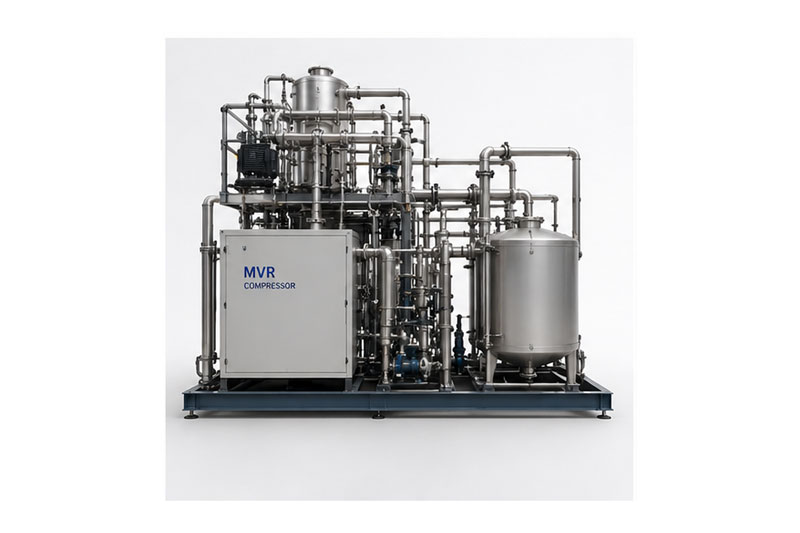
From a procurement perspective, the 1,000 kg/h MVR Wastewater Evaporator is attractive because it combines evaporation capacity with operating economy. The compressor raises the temperature and pressure of the secondary vapor, allowing the vapor to return as a heat source instead of being wasted. This closed energy loop gives the MVR wastewater evaporator a clear advantage in many continuous-duty projects, especially where steam cost, utility availability, and plant energy strategy are important. For buyers comparing a wastewater evaporation system with traditional thermal equipment, the MVR route is often chosen when operating cost is more important than the lowest possible initial equipment price.
The 1,000 kg/h MVR Wastewater Evaporator can be supplied with PLC/HMI control for automatic continuous operation, and its design can include condensate recovery, automatic discharge, and other project-specific functions. Depending on wastewater composition, the MVR wastewater evaporator may use SS304, SS316L, duplex stainless steel, titanium, or other corrosion-resistant materials in key sections. This flexibility helps the wastewater evaporation system handle aggressive media more safely and supports long-term process stability. When combined with pretreatment, anti-foam measures, or cleaning provisions, the MVR wastewater evaporator becomes easier to operate in real industrial conditions.
Typical applications for the 1,000 kg/h MVR Wastewater Evaporator include lithium battery wastewater, battery-material wastewater, electroplating wastewater, chemical wastewater, pharmaceutical wastewater, industrial brine concentration, membrane concentrate, and RO concentrate. In many of these cases, the MVR wastewater evaporator is not used as a standalone unit only; it is part of a wider wastewater evaporation system that may also include pretreatment, preheating, polishing, or crystallization. For projects aiming at higher water recovery or ZLD integration, the MVR wastewater evaporator can be connected downstream to a crystallizer or other solid-separation equipment.
The operating principle is straightforward and well suited to continuous plants. First, wastewater enters the system and is preheated where recovered thermal energy is available. Next, part of the water evaporates into secondary vapor. The MVR compressor then recompresses that vapor, increasing its temperature and pressure so it can return to the heating section. As heat transfer continues, the vapor condenses, condensate can be collected, and the remaining liquid becomes more concentrated. This makes the MVR wastewater evaporator efficient in applications where a wastewater evaporation system must deliver reliable concentration without excessive steam demand.
A typical process flow for the 1,000 kg/h MVR Wastewater Evaporator may include feed tank, pretreatment, preheater, evaporator, vapor-liquid separator, compressor, and heating chamber, followed by condensate collection and concentrate discharge. The exact arrangement depends on the feed characteristics and the desired final concentration. For instance, membrane concentrate or RO concentrate may need only a compact wastewater evaporation system, while a difficult industrial brine may require stronger pretreatment or forced circulation. In both cases, the MVR wastewater evaporator is chosen because it supports continuous operation and can be integrated into a broader water-recovery strategy.
Key Features
- 1,000 kg/h nominal evaporation capacity
- Energy‑saving MVR technology
- Vapor heat recovery
- Reduced fresh‑steam demand
- Automatic continuous operation
- Condensate recovery
- High concentration capability
- PLC/HMI control
- Multiple corrosion‑resistant materials
- ZLD integration available
Typical Applications
- Lithium battery wastewater
- Battery‑material wastewater
- New‑energy manufacturing
- Electroplating wastewater
- Chemical wastewater
- High‑salinity industrial wastewater
- Pharmaceutical wastewater
- Metal‑finishing wastewater
- Membrane concentrate
- RO concentrate
- Industrial brine concentration
Reference Technical Parameters
| Parameter |
Reference Specification |
| Evaporation Capacity |
1,000 kg/h |
| Technology |
Mechanical Vapor Recompression |
| Operation |
Continuous |
| Compressor |
Project‑specific |
| Feed Concentration |
Project‑specific |
| Final Concentration |
Project‑specific |
| Main Heat Source |
Recompressed secondary vapor |
| Startup Heat Source |
Steam / electric / project‑specific |
| Operating Pressure |
Vacuum / process‑specific |
| Main Material |
SS304 / SS316L / duplex / titanium optional |
| Condensate Recovery |
Available |
| PLC/HMI |
Standard / recommended |
| CIP System |
Optional |
| Anti‑Foam System |
Optional |
| Automatic Discharge |
Available |
| Remote Monitoring |
Optional |
How MVR Evaporation Works
Step 1 — Wastewater Preheating
Incoming wastewater is preheated using recovered thermal energy where appropriate.
Step 2 — Evaporation
Wastewater enters the evaporation section and part of the water is converted into secondary vapor.
Step 3 — Vapor Compression
The MVR compressor increases the pressure and temperature of the secondary vapor.
Step 4 — Heat Reuse
The compressed vapor returns to the heating section and supplies latent heat for further evaporation.
Step 5 — Condensate Recovery
After heat transfer, the vapor condenses and can be collected for discharge, polishing or reuse.
Step 6 — Concentrate Discharge
Salts, non‑volatile organics and other contaminants become concentrated in a smaller wastewater volume.
Typical Process Flow
Feed Tank → Pretreatment → Preheater → MVR Evaporator → Vapor‑Liquid Separator → MVR Compressor → Heating Chamber
Water recovery:
Condensed Vapor → Condensate Tank → Polishing / Reuse
Concentrate:
Evaporator Bottoms → Concentrate Tank → Further Concentration / Disposal
Why MVR Saves Energy
Traditional evaporation systems may require significant external steam.
MVR recovers secondary vapor and reuses its heat inside the evaporation process.
The compressor supplies mechanical energy, allowing much of the latent heat to circulate within the system.
As a result, MVR can substantially reduce dependence on fresh steam in suitable continuous applications.
Actual electricity consumption depends on:
- Feed temperature
- Evaporation load
- Boiling‑point elevation
- Compressor efficiency
- Wastewater concentration
- System pressure
- Heat‑exchanger design
- Target final concentration
Customization Options
- Forced‑circulation evaporator
- Falling‑film evaporator
- MVR compressor selection
- Preheating heat recovery
- SS316L
- Duplex stainless steel
- Titanium heat exchangers
- Special corrosion‑resistant alloys
- Automatic antifoam dosing
- Descaling system
- CIP cleaning
- pH adjustment
- Oil‑removal pretreatment
- Membrane concentration pretreatment
- Condensate activated carbon
- Condensate RO
- Crystallizer integration
- PLC/HMI automation
- SCADA integration
- Remote monitoring
Typical Project Configuration
For high‑salinity industrial wastewater:
Wastewater → Pretreatment → Membrane Concentration Optional → MVR Evaporation → Concentrate
For higher water recovery:
MVR Condensate → Polishing → Reuse
For ZLD projects:
MVR Concentrate → Crystallizer → Salt / Solid Residue
MVR vs Conventional Evaporator
MVR is generally attractive when:
- Wastewater volume is relatively stable
- The system operates many hours per day
- Energy cost is important
- Steam supply is limited or expensive
- Wastewater concentration is suitable for continuous evaporation
- Long‑term operating cost matters more than only initial equipment cost
Conventional steam or electric evaporation may still be more suitable for certain small, intermittent or highly variable wastewater streams.
FAQ
What does MVR mean?
MVR means Mechanical Vapor Recompression. It compresses secondary vapor generated during evaporation and reuses the vapor as a heating source.
How much energy does an MVR evaporator consume?
Actual energy consumption depends on wastewater properties, boiling‑point elevation, compressor selection and operating conditions. Project‑specific calculations are required.
Does MVR require steam?
MVR systems may require an external heat source during startup or under certain operating conditions, but their main thermal energy is recovered from compressed secondary vapor during normal operation.
Can MVR treat high‑salt wastewater?
Yes. High‑salinity wastewater is a common MVR application, but scaling and corrosion must be evaluated during equipment selection.
Can MVR treat RO concentrate?
Yes. RO reject water or membrane concentrate can often be further concentrated using MVR evaporation as part of a high‑recovery or ZLD process.
Can the condensate be reused?
Yes, depending on condensate quality. Polishing processes such as activated carbon, RO, ion exchange or other treatment may be required.
Is a crystallizer always required?
No. A crystallizer is required only when the project target includes further salt separation or near/complete Zero Liquid Discharge.
How do you choose between falling‑film and forced‑circulation evaporation?
Selection depends on viscosity, solids, scaling tendency, crystallization risk and wastewater composition. Forced circulation is often preferred for difficult scaling or higher‑solids streams.
Recommended CTA
Evaluating an MVR evaporator for high‑salinity wastewater?
Send us your wastewater composition, hourly/daily flow, salt concentration and required final concentration. We can evaluate MVR energy consumption, evaporation capacity and material selection.
CTA Button: Request MVR Evaporator Design

 EN