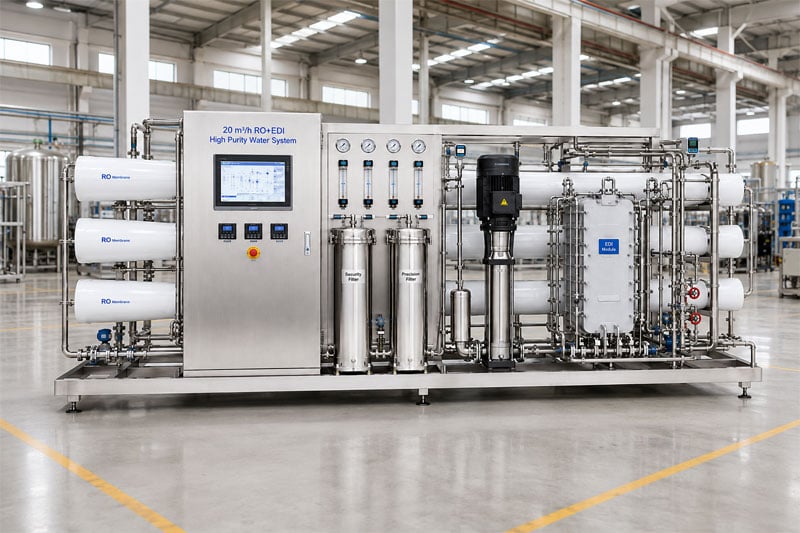
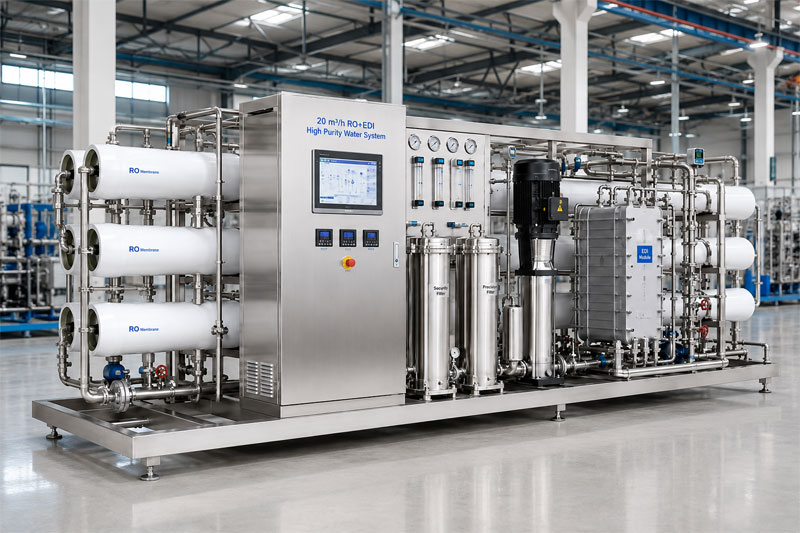
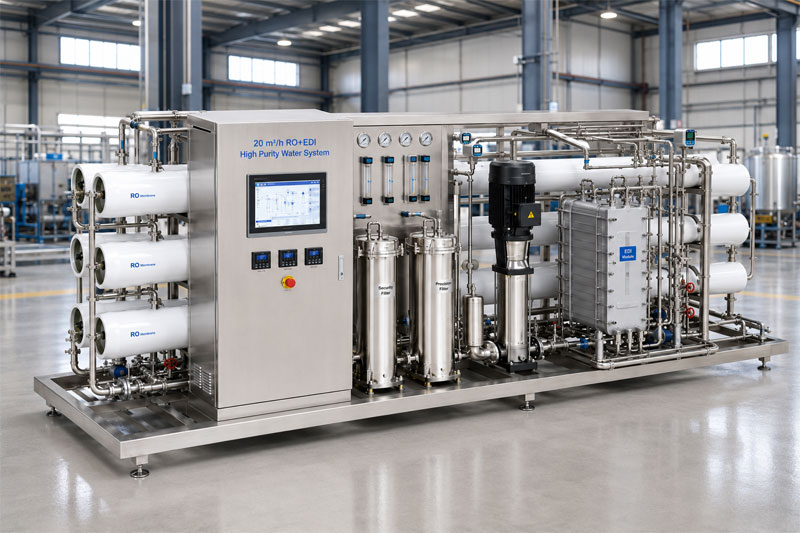
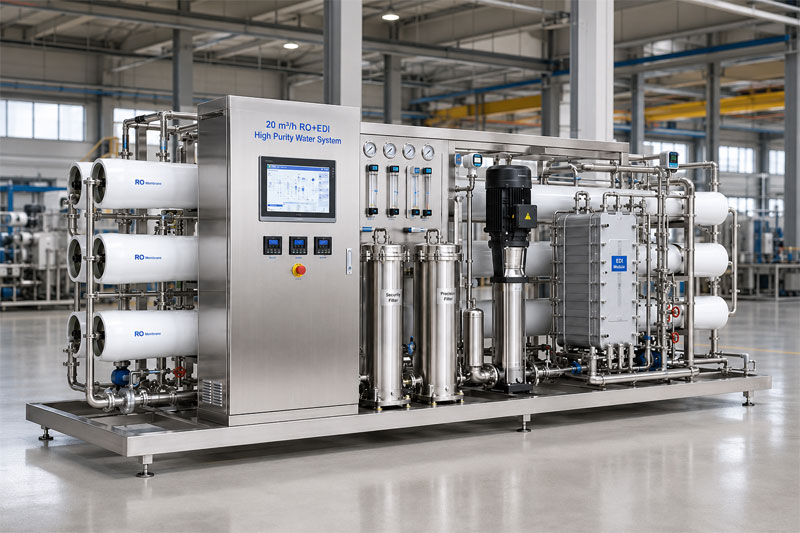
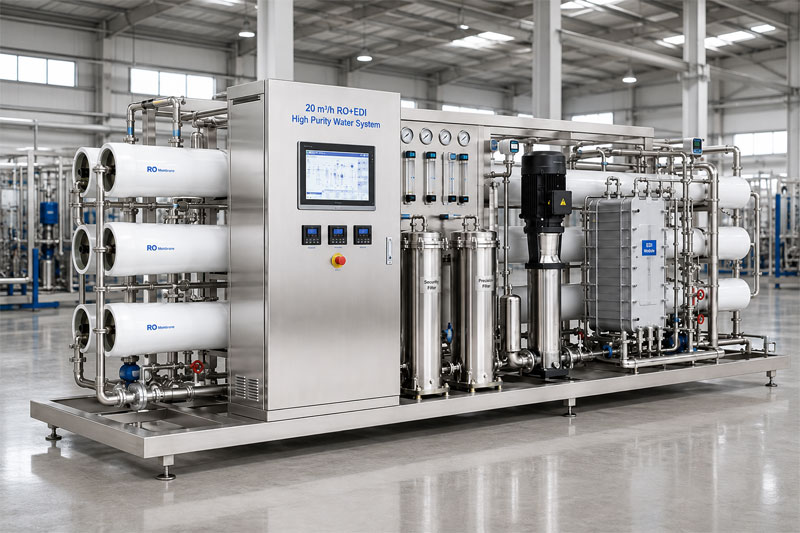
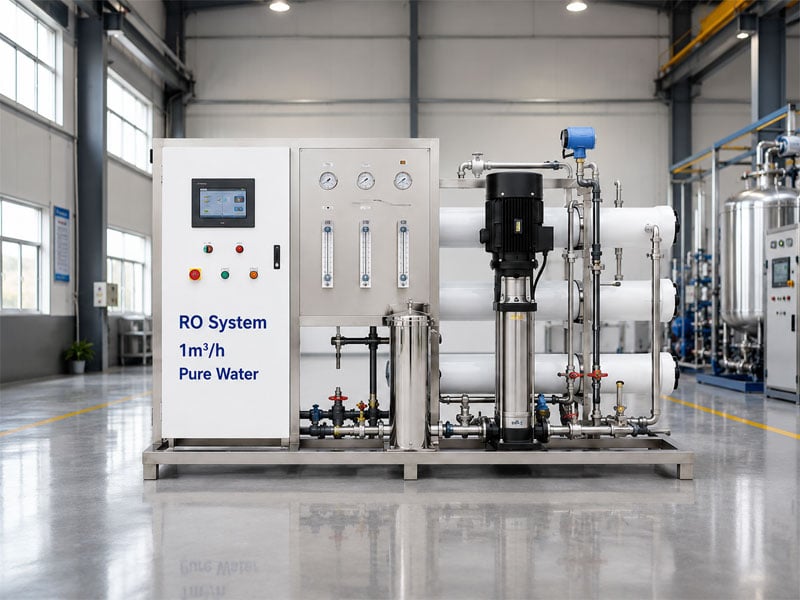
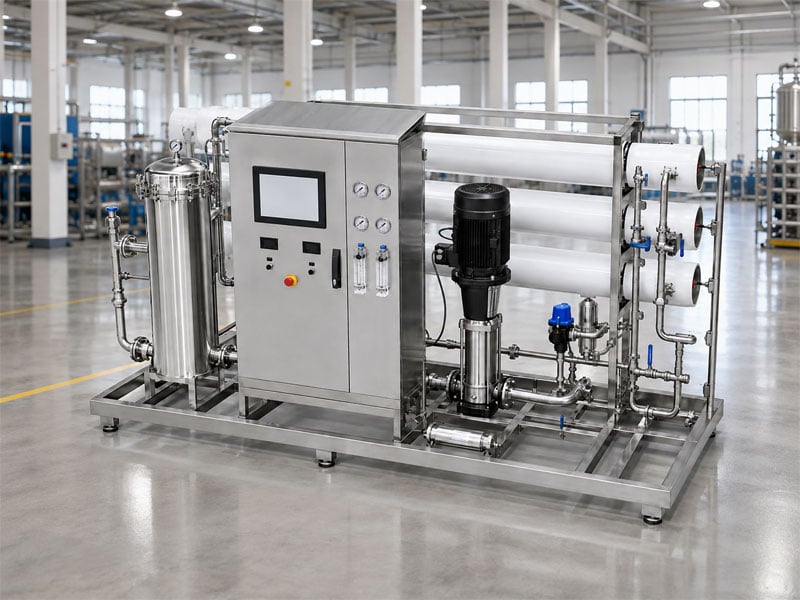
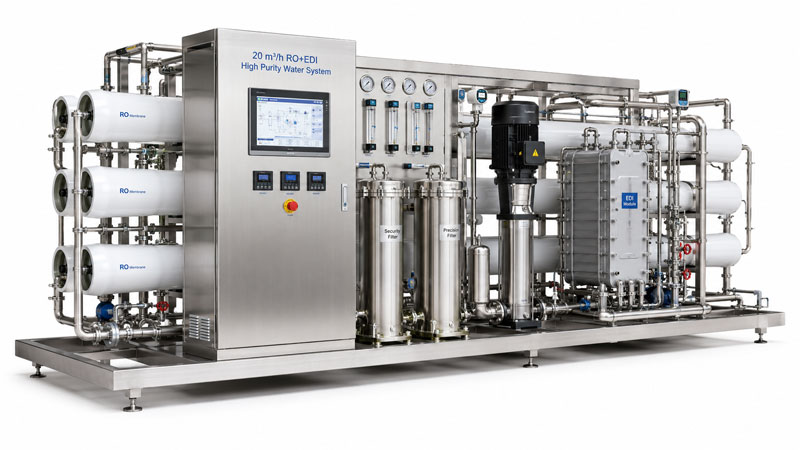
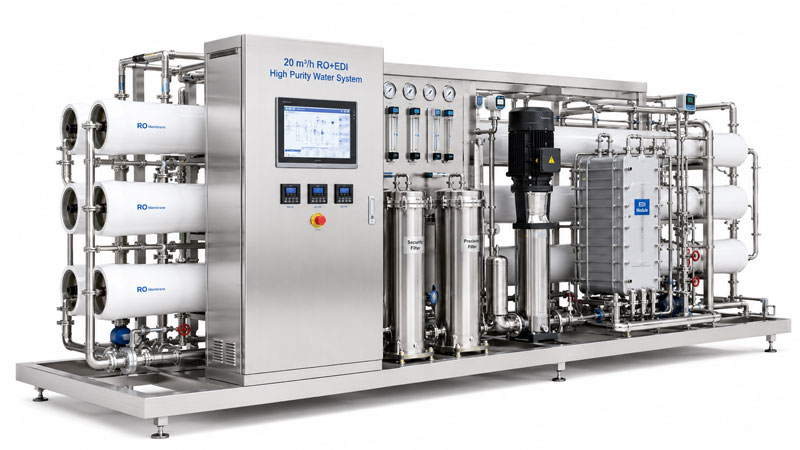
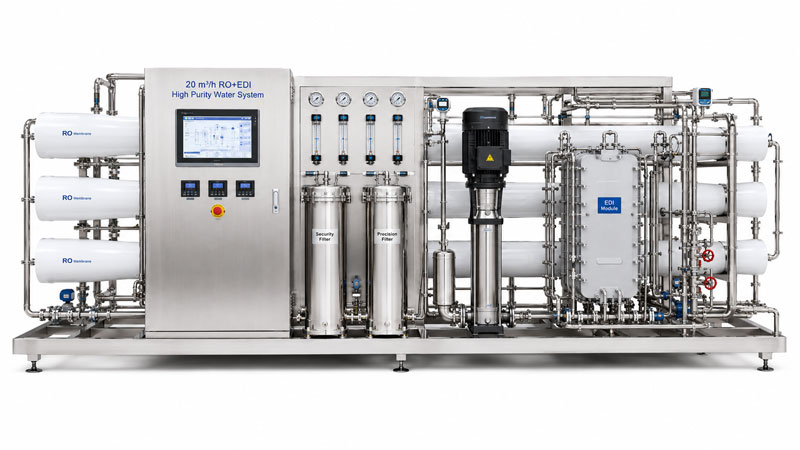
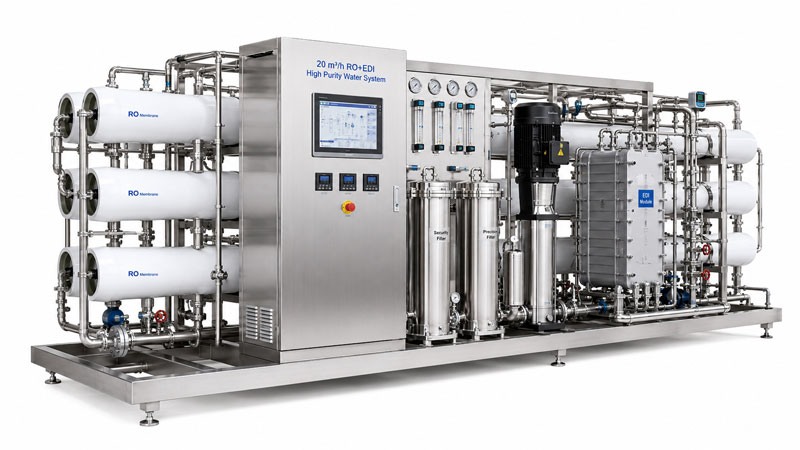
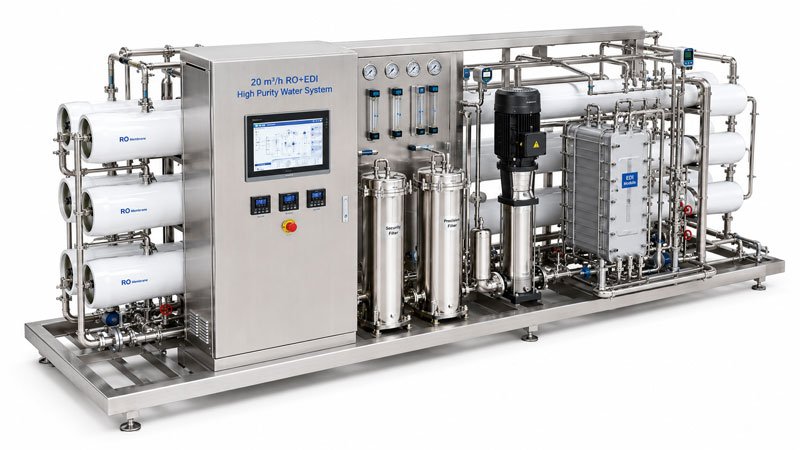
20 m³/h RO + EDI High Purity Water System
The 20 m³/h RO + EDI High Purity Water System is a modular, automated water treatment solution engineered for stable, continuous high-standard process water supply. Integrating reverse osmosis and continuous electrodeionization, this RO EDI water system outperforms traditional mixed-bed ion exchange systems by eliminating frequent acid and caustic regeneration, featuring simpler operation, precise process control and consistent water quality. As a professional reverse osmosis EDI system, it effectively stabilizes water conductivity and reduces ionic contamination, which is critical for safeguarding production yield and downstream process stability.
This high purity water system adopts a flexible and configurable layered process structure, covering complete links including raw water pretreatment, single/double-pass RO desalination and EDI deep polishing. It can be further equipped with UF filtration, degassing, TOC control, UV sterilization and final polishing devices to adapt to diverse water quality standards. Matched with high-purity water tanks and circulating distribution loops, the RO EDI water system maintains stable water quality after treatment, delivering reliable water supply for production terminals. Its modular design enables customized configuration based on actual feed water conditions and target specifications.
Built for long-term industrial continuous operation, the reverse osmosis EDI system supports full automatic control via PLC/HMI, with real-time online monitoring of conductivity and resistivity. Optional SCADA integration realizes intelligent remote management. The RO stage first removes most dissolved salts to lower ionic load, protecting the EDI module and laying a foundation for efficient deep purification. This collaborative working mode makes the 20 m³/h RO + EDI High Purity Water System highly adaptable to high-intensity industrial production scenarios.
In terms of operational and procurement value, the high purity water system cuts chemical usage and manual maintenance workload by omitting repeated regeneration, greatly reducing lifecycle operating costs. Tailorable pretreatment, RO configuration and EDI capacity can cope with different feed water indicators such as hardness and residual chlorine, ensuring long-term stable operation. Supporting step-by-step upgrading and expansion, the RO EDI water system can add redundant pumps, alarm systems and bypass structures to enhance production resilience.
Widely applied in lithium battery, photovoltaic, semiconductor, electronics and precision manufacturing industries, the reverse osmosis EDI system can be tailored with sanitary stainless steel piping, nitrogen blanketing and heat sanitization structures to meet high-end production demands. With project-oriented customized design, the 20 m³/h RO + EDI High Purity Water System avoids over-design while fully meeting production requirements, serving as a scalable and efficient core utility platform for high-purity water preparation in advanced manufacturing.
Key Features
- Integrated RO + EDI process
- 20 m³/h high-purity water production
- Continuous deionization
- Reduced chemical regeneration requirement
- Stable conductivity control
- PLC/HMI automatic operation
- Online conductivity/resistivity monitoring
- Double-pass RO available
- UV and polishing treatment optional
- Suitable for high-value industrial processes
Typical Applications
- Lithium battery manufacturing
- Battery material production
- Photovoltaic manufacturing
- Electronics factories
- Semiconductor supporting processes
- Precision cleaning
- Pharmaceutical process-water pretreatment
- Laboratory centralized water supply
- High-purity chemical production
- Advanced manufacturing
- Industrial high-purity rinsing
Reference Technical Parameters
| Parameter |
Reference Specification |
| Product Water Flow |
20 m³/h |
| Main Process |
RO + EDI |
| RO Configuration |
Single-pass / double-pass |
| EDI Capacity |
Project-matched |
| Product Conductivity |
Project-specific |
| Product Resistivity |
Project-specific |
| Feed-Water Pretreatment |
Customized |
| CO₂ Removal |
Optional |
| UV Sterilization |
Optional |
| Final Polishing |
Optional |
| Online Conductivity |
Available |
| Online Resistivity |
Available |
| TOC Monitoring |
Optional |
| PLC/HMI |
Standard / recommended |
| SCADA Integration |
Optional |
| Distribution Loop |
Optional |
Typical Process Flow
A common high-purity water configuration may include:
Raw Water → Multimedia / UF Pretreatment → Activated Carbon or Dechlorination → Softening / Antiscalant → Cartridge Filter → First-Pass RO → Second-Pass RO → EDI → UV → High-Purity Water Tank
For higher water-quality requirements:
RO → EDI → UV → Polishing Mixed Bed / UF → High-Purity Water Distribution Loop
Final configuration should be selected according to feed-water analysis and required water specifications.
How It Works
Step 1 — Pretreatment
Pretreatment protects RO membranes from suspended solids, chlorine, hardness, organic contamination and scaling.
Step 2 — Reverse Osmosis
RO removes the majority of dissolved salts and significantly reduces the ionic load entering the EDI system.
Step 3 — EDI Polishing
EDI uses ion-exchange media, ion-selective membranes and a DC electric field to continuously remove remaining ions from RO permeate.
Step 4 — Final Treatment
UV, degassing, ultrafiltration or polishing systems can be added where stricter microbial, TOC or ionic specifications are required.
Step 5 — High-Purity Water Distribution
Finished water enters a storage and circulation system designed according to the downstream production process.
Why Use RO + EDI?
RO and EDI perform different functions.
RO removes most dissolved salts and reduces the contaminant load.
EDI then continuously removes residual ions, allowing the system to achieve significantly better product-water quality without routine acid and caustic regeneration of conventional ion-exchange beds.
This makes RO + EDI particularly suitable for continuous industrial high-purity water production.
Customization Options
- Ultrafiltration pretreatment
- Double-pass RO
- High-rejection RO membranes
- Membrane degassing
- CO₂ removal
- EDI module selection
- UV sterilization
- TOC reduction UV
- Polishing mixed bed
- Final ultrafiltration
- Stainless steel sanitary piping
- High-purity water tank
- Nitrogen blanketing
- Distribution loop
- Heat sanitization design
- Online conductivity
- Online resistivity
- Online TOC monitoring
- PLC/HMI
- SCADA communication
- Remote monitoring
- Redundant pumps
- Local electrical standards
Typical Customer Concerns
Water Quality Stability
High-purity manufacturing processes often require stable water quality rather than only achieving a specification temporarily.
The control strategy, instrumentation, membrane design and EDI operating conditions should therefore be considered as an integrated system.
Chemical Consumption
EDI reduces the need for routine acid and caustic regeneration used in conventional mixed-bed ion exchange processes.
System Reliability
For continuous production plants, duty/standby pumps, buffer tanks, automatic alarms and bypass strategies can be incorporated.
Future Expansion
The system can be designed with space, piping interfaces and electrical capacity for future production expansion.
FAQ
What is the difference between RO and EDI?
RO removes most dissolved salts using membrane separation. EDI is a polishing process that removes residual ionic contaminants from RO permeate.
Does EDI require chemical regeneration?
EDI operates continuously and does not normally require the routine acid and caustic regeneration used by conventional regenerable ion-exchange systems.
What water quality can RO + EDI produce?
Final conductivity or resistivity depends on RO permeate quality, EDI design, CO₂ concentration, temperature and downstream polishing requirements. The target specification should be confirmed during system design.
Can EDI treat raw water directly?
Normally no. EDI requires properly pretreated low-conductivity feed water, typically produced by RO.
Is double-pass RO required before EDI?
Not in every project. Double-pass RO may be recommended when feed-water conditions or target high-purity water specifications require lower ionic and CO₂ loading before EDI.
Can the system be used for semiconductor ultrapure water?
RO + EDI can be an important pretreatment and primary deionization section of a semiconductor ultrapure water plant. Semiconductor-grade UPW normally requires additional polishing processes based on the required specification.
Is this system suitable for lithium battery production?
Yes. RO + EDI systems are widely applicable to high-purity process-water requirements in lithium battery and battery-material production. Final specifications should be matched to the specific production process.
Can the system include a high-purity distribution loop?
Yes. High-purity tanks, circulation pumps, sanitary piping and distribution loops can be integrated.
Recommended CTA
Need high-purity water for electronics, battery or advanced manufacturing?
Send us your feed-water analysis, required flow rate, conductivity or resistivity target and application. Our engineering team can design the complete RO + EDI process and polishing configuration.
CTA Button: Get RO + EDI System Design

 EN